
Operational AI in Logistics: Where It Actually Works (and Where It Doesn’t)
An executive guide for mid-market logistics leaders on where Operational AI delivers measurable results today, where it falls short, and how to start without hype or overreach.
Logistics and field operations leaders are facing pressure from nearly every direction. Demand is less predictable. Customers expect faster delivery and real-time visibility. Labor remains difficult to hire and retain. Transportation, insurance, and compliance costs continue to rise.
At the same time, many organizations feel they should be “doing something with AI,” yet prior pilots often stalled or never scaled.
This article takes a grounded, execution-focused view. It focuses on Operational AI—AI embedded directly into day-to-day workflows, with clear ownership and measurable operational outcomes. Not dashboards built for curiosity. Not pilots with no operational home. But systems that change how work gets done.
The objective is simple: help mid-market logistics leaders understand where AI is already working in real operations, where it does not yet hold up, and how to approach early initiatives with discipline and realism.
1. Logistics pressures
Logistics has always been complex. What has changed is the number and intensity of pressures hitting operations simultaneously.
Demand volatility remains elevated. McKinsey reports that supply chain variability is still well above pre-2020 levels, driven by shifting consumer behavior, geopolitical instability, and supplier concentration. Labor shortages persist across trucking, warehousing, and field services. The American Trucking Associations estimated a driver shortage of more than 60,000 in the US in 2023, with no near-term resolution.
Meanwhile, customer expectations have moved faster than operational capability. Real-time updates, narrow delivery windows, and consistent service are now table stakes.
For mid-market operators, these pressures show up in very practical ways: more exceptions, more manual coordination, more overtime and expediting, more customer escalations.
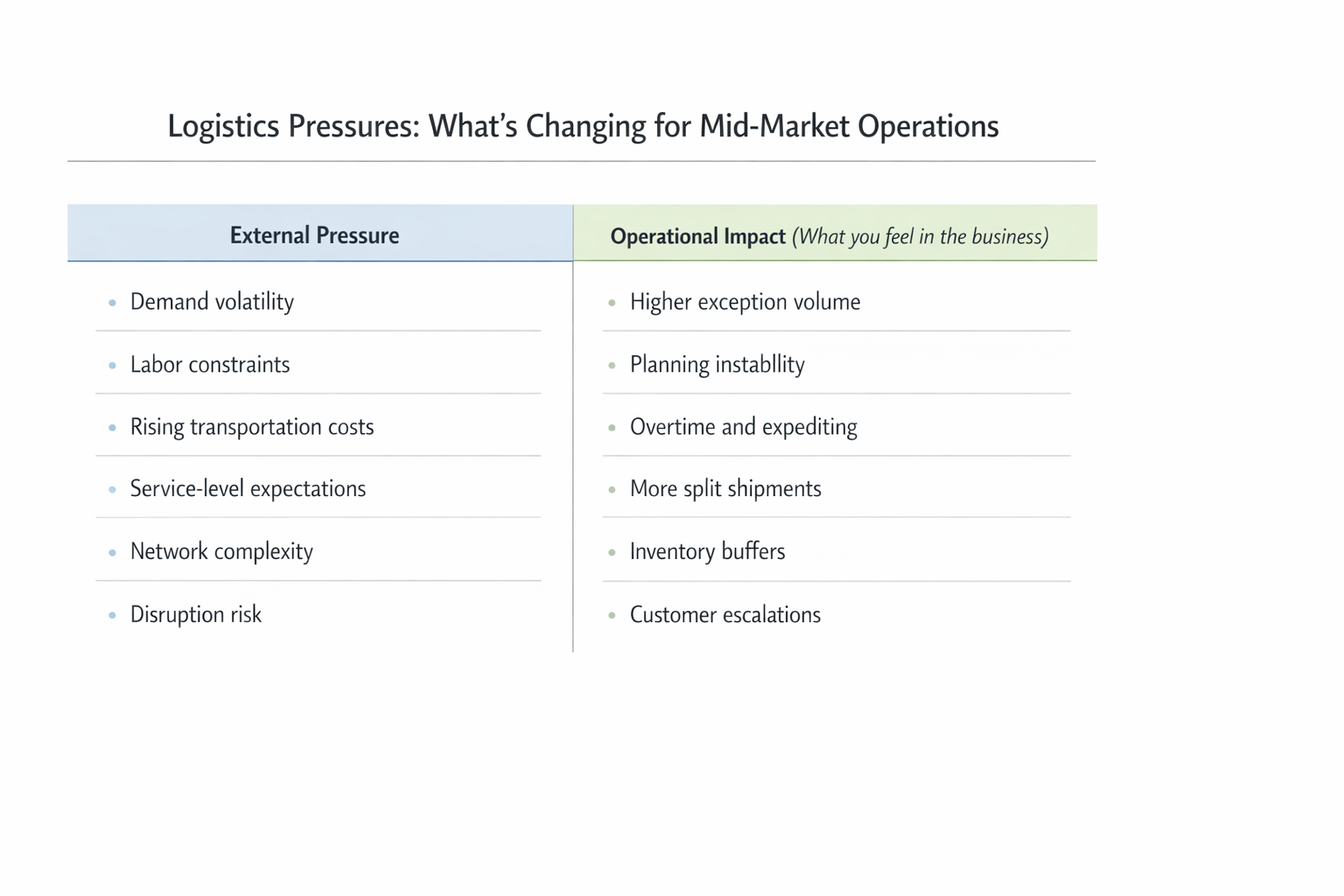
Logistics Pressures: What’s Changing for Mid-Market Operations
The important point is this: complexity is no longer episodic. It is structural.
2. Common pain points
When logistics leaders describe their operations, one word appears again and again: firefighting.
Most breakdowns do not originate in core planning logic. They originate in exceptions. A late inbound shipment. A driver call-out. A warehouse miss-pick. A last-minute customer change. Each exception triggers a cascade of manual work across dispatch, operations, customer service, and finance.
Gartner research shows that in many logistics organizations, more than 30% of daily operational effort is spent handling exceptions—not executing the plan. These exceptions quietly accumulate cost through expedited freight, overtime labor, SLA penalties, and customer churn risk.
The deeper issue is structural rather than tactical:
- Visibility is fragmented across systems
- Rules live in people’s heads
- Decisions happen through calls, emails, and spreadsheets
- Feedback loops are weak, so the same problems repeat
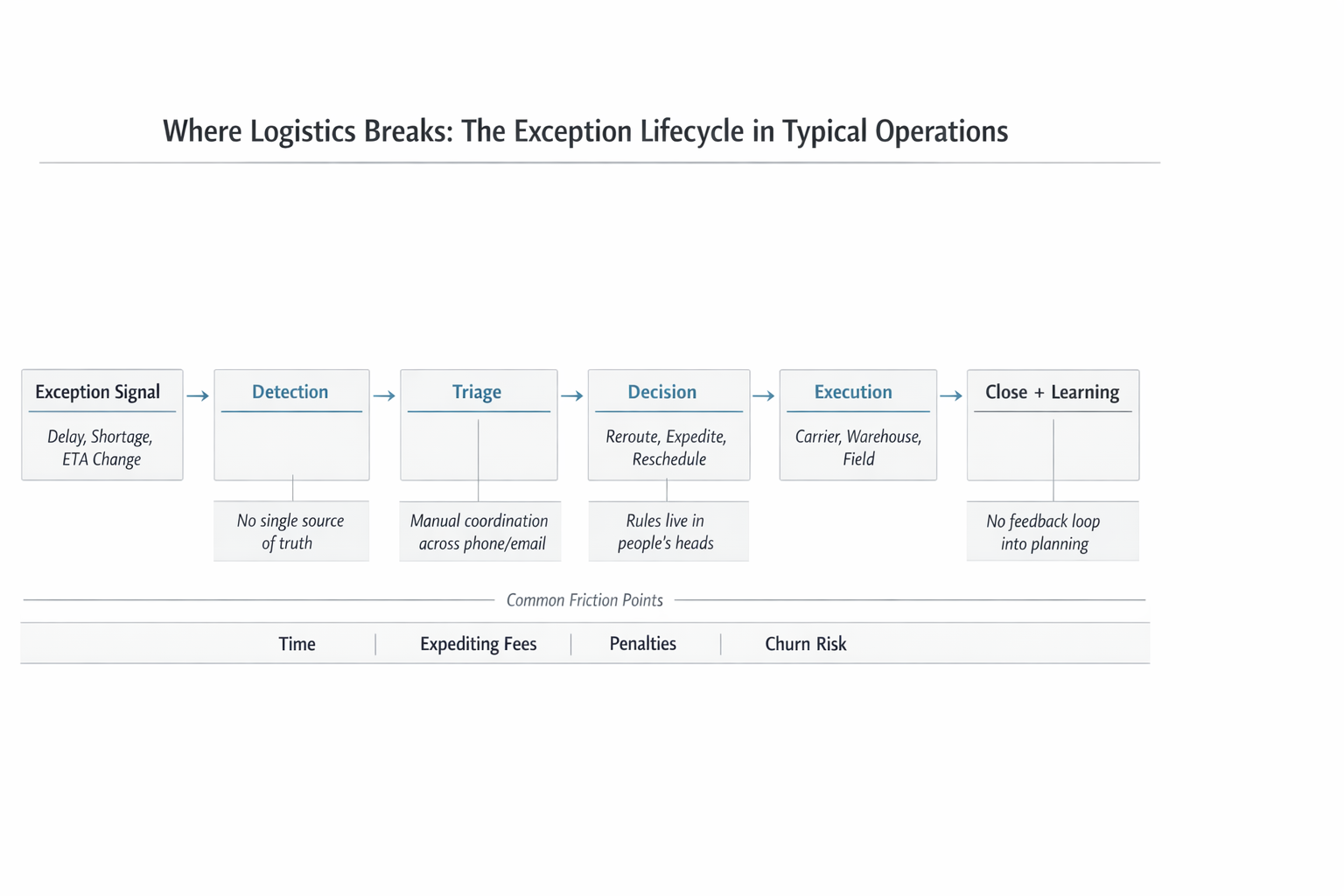
Where Logistics Breaks: The Exception Lifecycle in Typical Operations
This is the environment in which AI is being introduced. And it explains why many initiatives struggle.
3. AI use cases
Defining Operational AI
Before discussing use cases, it is important to clarify terms. In this article, Operational AI is treated as a defined concept:
AI embedded in an operational workflow, with a named business owner, integrated into existing systems, and measured against operational KPIs such as cost, cycle time, service level, or error rate.
This definition matters because many AI initiatives fail not due to technology, but due to lack of operational ownership.
Where AI actually works today
Across logistics and other slow-adoption industries, several AI use cases consistently deliver value when implemented with discipline.
Document processing
One of the most reliable wins. AI-based extraction of invoices, bills of lading, and proof-of-delivery documents can reduce manual processing time by 50 to 70% while improving accuracy. Trax Technologies reports accuracy rates above 95% in production environments.
Exception detection and triage
Instead of humans scanning reports, AI monitors events in real time and flags shipments, routes, or orders that deviate from expected patterns. Humans still decide what to do, but their attention is focused where it matters.
ETA prediction and route re-optimization
Models continuously update arrival times based on traffic, weather, and execution data. McKinsey estimates that advanced routing and scheduling can reduce transportation costs by 5 to 10% while improving on-time delivery.
Inventory anomaly detection
AI flags unexpected demand spikes, slow-moving stock, or mismatches between systems, allowing planners to intervene earlier.
Where AI struggles or should be staged carefully
Other ideas remain high-risk for mid-market operators:
- Fully autonomous end-to-end planning across multiple partners
- General-purpose chatbots without workflow integration
- Speculative robotics requiring heavy capital investment
These initiatives often fail not because AI is weak, but because data fragmentation, partner constraints, and real-world variability still require human judgment.
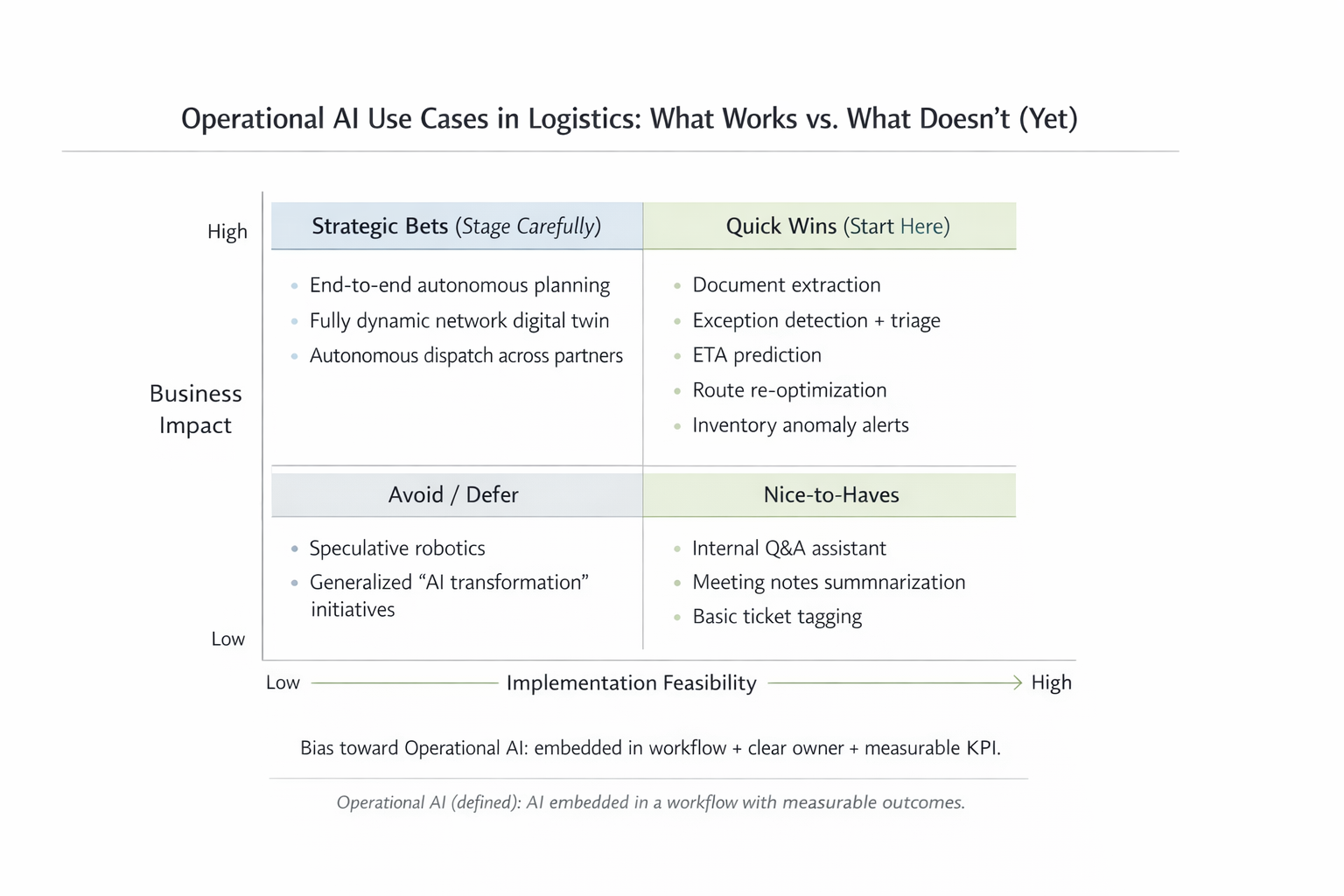
Operational AI Use Cases in Logistics: What Works vs. What Doesn’t (Yet)
4. Example workflows
The most effective way to understand Operational AI is through workflows, not models.
Consider dispatch and route management.
✕ Before AI
- Routes built manually each morning
- Exceptions handled reactively
- Dispatchers and customer service scramble to replan
- Updates are inconsistent
- Little learning occurs
✓ With Operational AI
- AI proposes routes with confidence scores
- Dispatchers review and approve
- Execution is monitored continuously
- Risks are flagged early
- AI suggests reroute options—humans approve
- Customers receive consistent updates
- KPIs are logged automatically
This is not autonomy. It is augmentation.
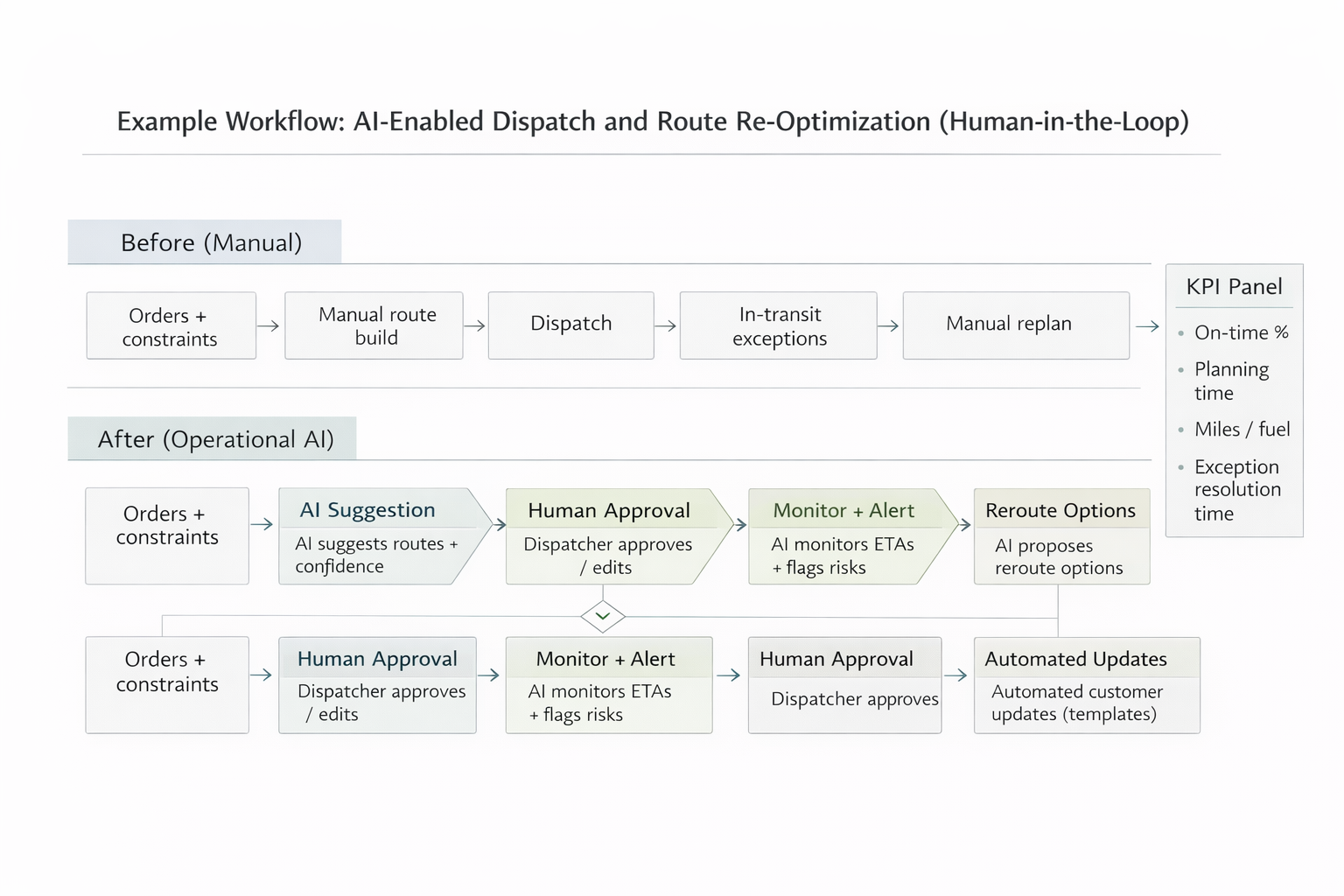
Example Workflow: AI-Enabled Dispatch and Route Re-Optimization (Human-in-the-Loop)
The same pattern appears in other industries. Hospitals use AI to improve operating room scheduling, increasing utilization by 5 to 10% while clinicians retain control. Manufacturers use predictive maintenance to reduce downtime without removing engineers from decisions.
Operational AI works best when it supports people, not replaces them.
5. Data requirements
Many AI initiatives stall because organizations overestimate what data they need to start.
Operational AI does not require perfect data. It requires sufficient, consistent, and visible data.
For pilots, this often includes event timestamps, status codes, and basic master data. For production deployment, additional elements become critical: standard reason codes, API-based integrations, and data quality rules.
The most common blockers are not data volume, but inconsistency—different systems describing the same event differently, exceptions handled manually without logging.
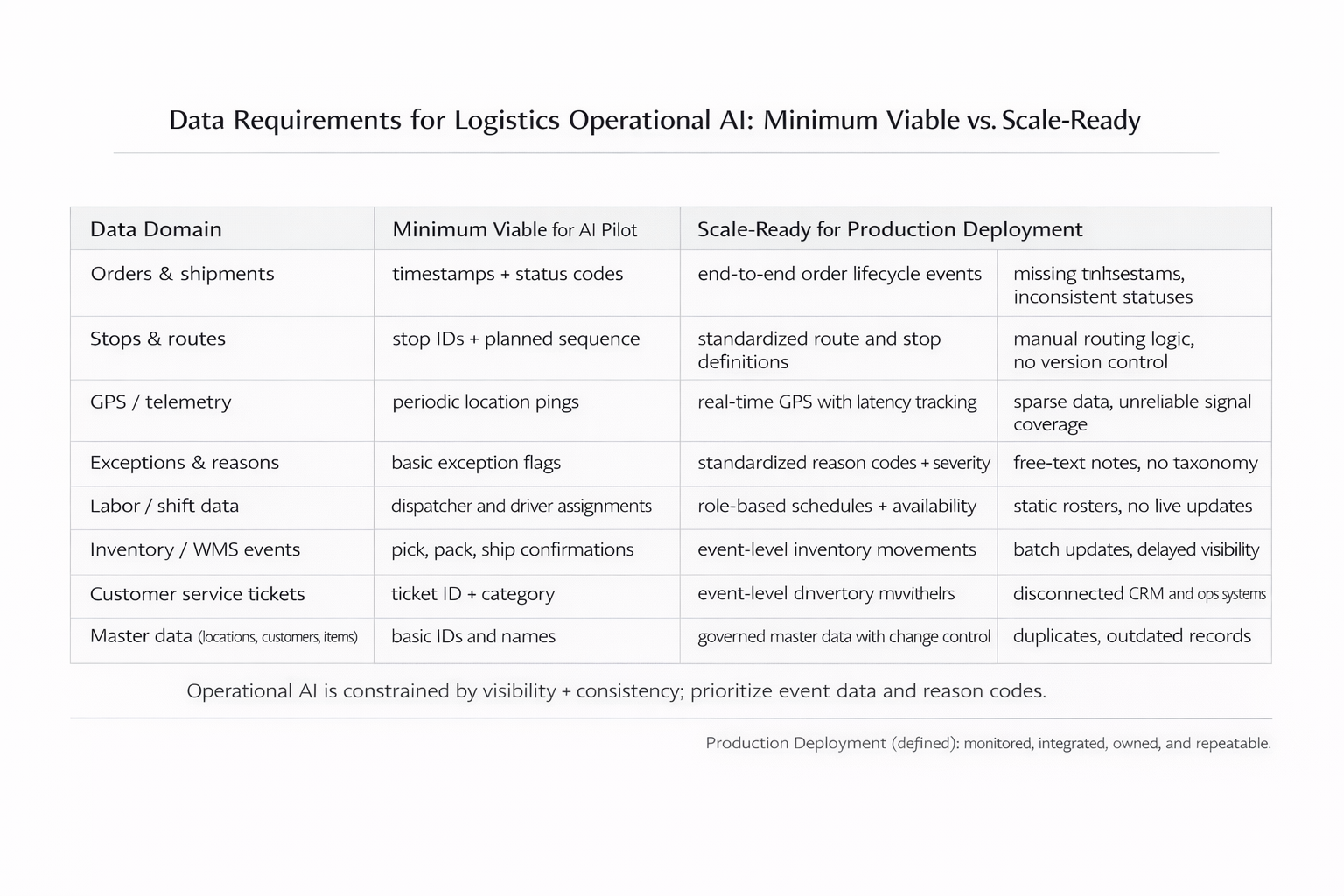
Data Requirements for Logistics Operational AI: Minimum Viable vs. Scale-Ready
6. Pilot ideas
For mid-market logistics organizations, the strongest pilots share four traits:
- Narrow scope
- Workflow integration
- Measurable outcomes
- Clear ownership
Effective starting points include:
- Automated freight invoice processing — owned by Finance
- Exception detection for late shipments — owned by Operations
- ETA prediction and proactive customer updates — owned by Customer Experience
- Inventory anomaly alerts — owned by Planning
What to avoid early:
- Pilots spanning too many systems
- Initiatives without adoption plans
- Promises of full automation without readiness
Executive FAQ
Is Operational AI only for large enterprises?
No. Many high-impact use cases are narrow, workflow-specific, and well suited to mid-market environments.
Will AI replace dispatchers or planners?
In practice, no. Successful deployments reduce manual effort and improve consistency while keeping humans in control.
How quickly can results be seen?
Well-scoped pilots often show measurable impact within 8 to 12 weeks, especially for document processing and exception management.
Key Takeaways for Business Leaders
- Operational AI succeeds when embedded in workflows, not layered on top as experiments
- Exceptions are the highest-leverage entry point for AI in logistics
- Human-in-the-loop designs outperform attempts at full autonomy
- Data consistency and visibility matter more than perfection
- Narrow, owned pilots deliver more value than broad transformations
- Treat AI as an operating capability, not a side project
Ready to Explore Operational AI for Logistics?
Sentia Digital works with mid-market organizations to identify practical AI opportunities and move them from pilot to production.
Start the Conversation →