
Reducing Friction, Not Warmth: How Operational AI Transforms Hospitality Without Losing the Human Touch
A practical guide for mid-market operations leaders on how to apply AI to reduce friction in hospitality workflows while preserving guest connection.
Executive Summary
Labor shortages, service inconsistencies, and operational bottlenecks continue to challenge hospitality organizations. For mid-market operators, these issues drain morale, hurt guest satisfaction, and increase costs.
Operational AI offers a practical path forward by automating repetitive tasks, surfacing insights, and coordinating workflows—without compromising the human element that defines hospitality.
What Problem Are We Solving? Operational Friction in Hospitality
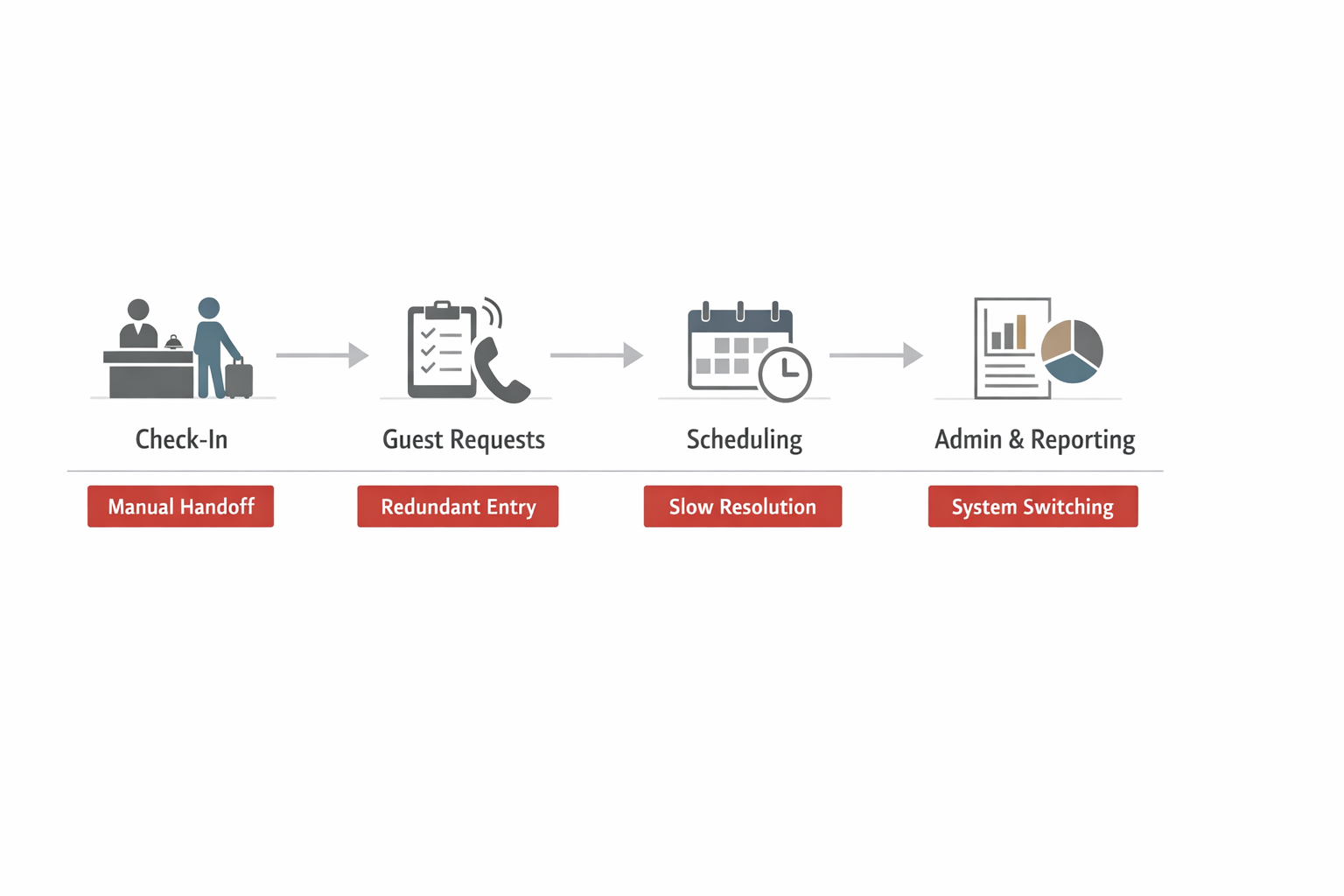
Operational Friction in Hospitality Workflows
Mid-market hospitality businesses face daily operational pain points: long front desk queues, staff juggling multiple systems, and unresolved guest requests. These issues stem from systemic friction—manual work, disconnected tools, and repetitive admin that overwhelm staff and disappoint guests.
Compounding the issue, hospitality turnover rates often exceed 70% annually, meaning teams are constantly retraining and struggling to maintain consistency.
Why This Matters: Operational Strain Equals Financial Risk
Friction isn’t just inconvenient—it’s expensive:
- 13% of operational spend is wasted due to inefficiency from disconnected systems
- Managers lose up to 286 hours annually switching between platforms—the equivalent of 36 full workdays
- In restaurants, slow table turns and waitlist mismanagement cut revenue
- In hotels, room turnover delays lead to missed bookings
There are also hidden costs: poor reviews, rework, overtime, and burnout. Left unaddressed, these inefficiencies erode margins, morale, and brand reputation.
Defining the Terms: What Is Operational AI (and What Isn’t)?
Operational AI — AI applied within live workflows to automate, classify, route, predict, or assist tasks that happen daily.
AI Opportunity — A high-volume, rule-based task where automation or augmentation can reduce cost or time.
AI Pilot — A small-scale, time-bound implementation to test feasibility and ROI.
Feasibility — The readiness to implement AI based on available data, workflow structure, and organizational alignment.
Orchestration Platform — A layer that connects AI, data, and systems to deliver coordinated outcomes reliably.
How This Works in Practice: Where AI Helps—and Where It Doesn’t
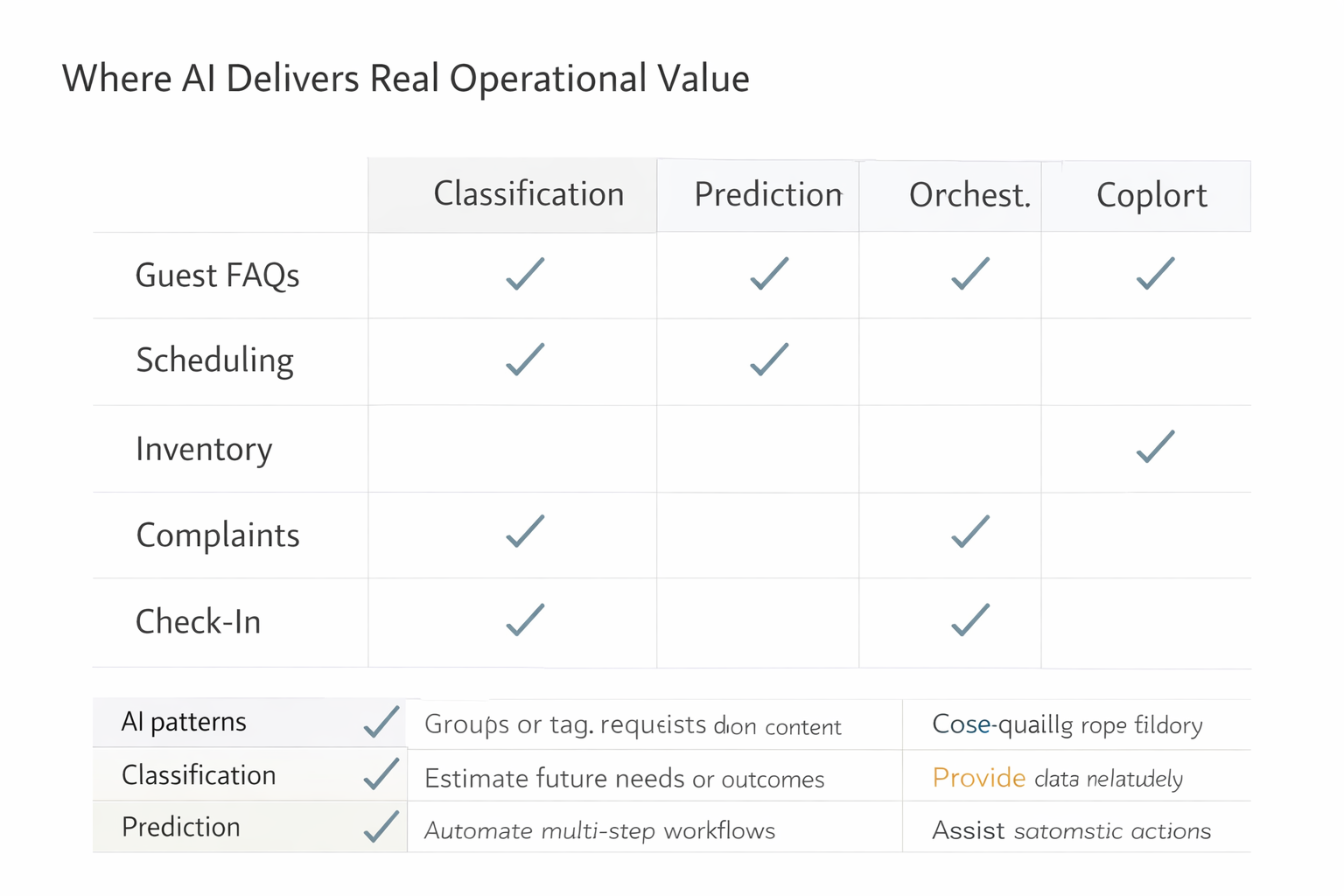
Where AI Delivers Real Operational Value
Operational AI is most effective in structured, repetitive, and high-volume tasks. In hospitality, this includes:
- Classification & Triage — Automatically routes guest requests or reviews to the right team
- Prediction — Forecasts staffing needs or demand based on historical and real-time data
- Orchestration — Automates multi-step workflows, like managing guest service requests
- Copilots — Provide staff with in-the-moment assistance, suggestions, or streamlined data entry
AI is not suitable for tasks requiring empathy or emotional intelligence. It shouldn’t replace staff in handling complaints or sensitive conversations. The goal is augmentation, not replacement.
Where It’s Already Working: Real Examples
Sunriver Resort
Implemented an AI phone assistant to reduce front-desk overload during peak season.
Pacific Northwest Health System
Used AI to optimize nurse scheduling across multiple facilities.
Mid-Sized 3PL
Automated warehouse and delivery workflows using AI for picking and routing.
What’s the First Step? Implementation Roadmap for Leaders
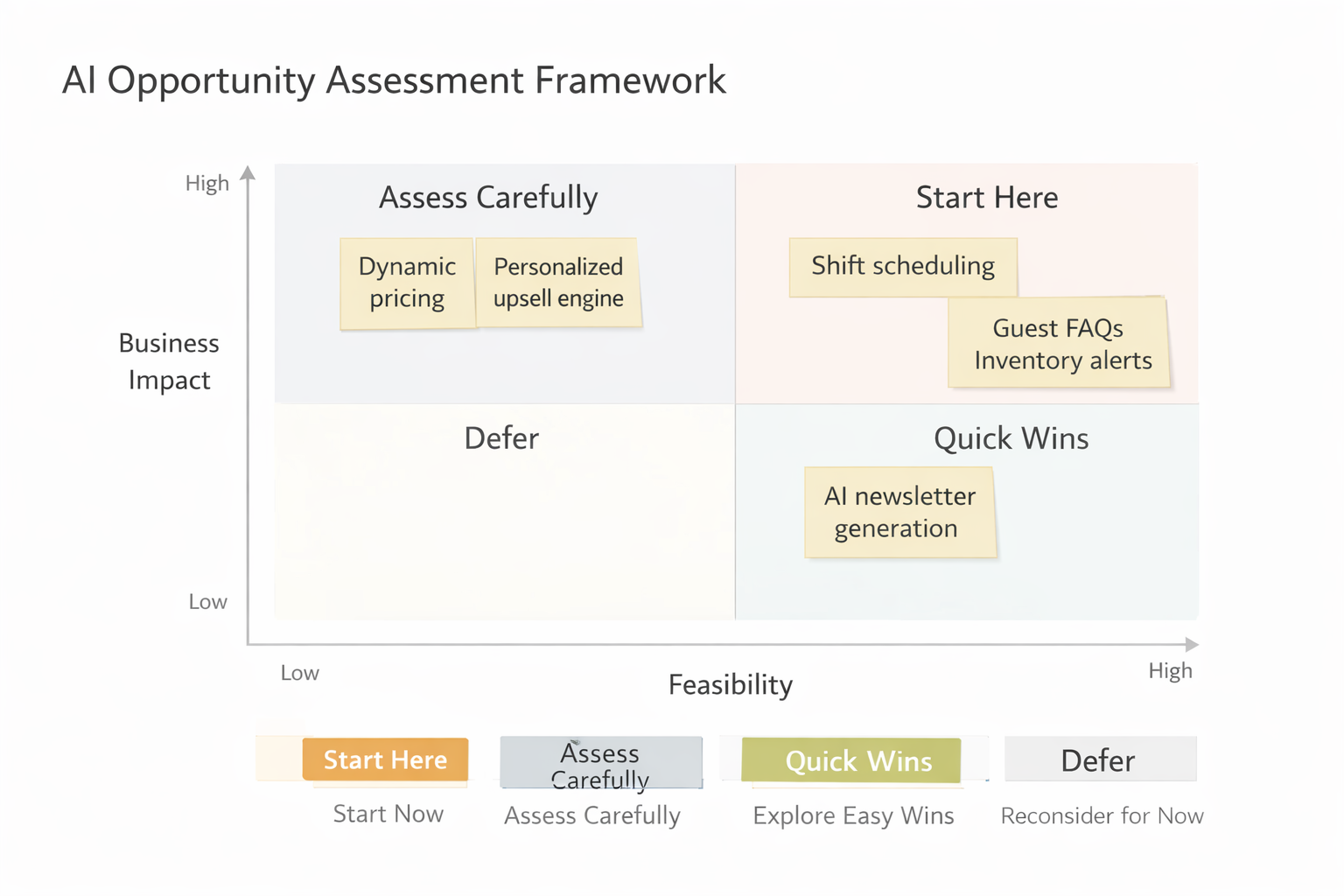
AI Opportunity Assessment Framework
Audit workflows
Identify recurring friction and manual steps that consume staff time.
Map AI patterns
Classify tasks as triage, prediction, orchestration, or support.
Prioritize by feasibility and ROI
Look at data readiness, system integration, and effort vs. impact.
Run a pilot
Keep scope small, set clear KPIs, and observe staff adoption.
Integrate properly
AI must connect to your existing tech stack (PMS, POS, CRM).
Scale thoughtfully
Expand only when results and processes are proven.
What Could Go Wrong? Common Pitfalls and How to Avoid Them
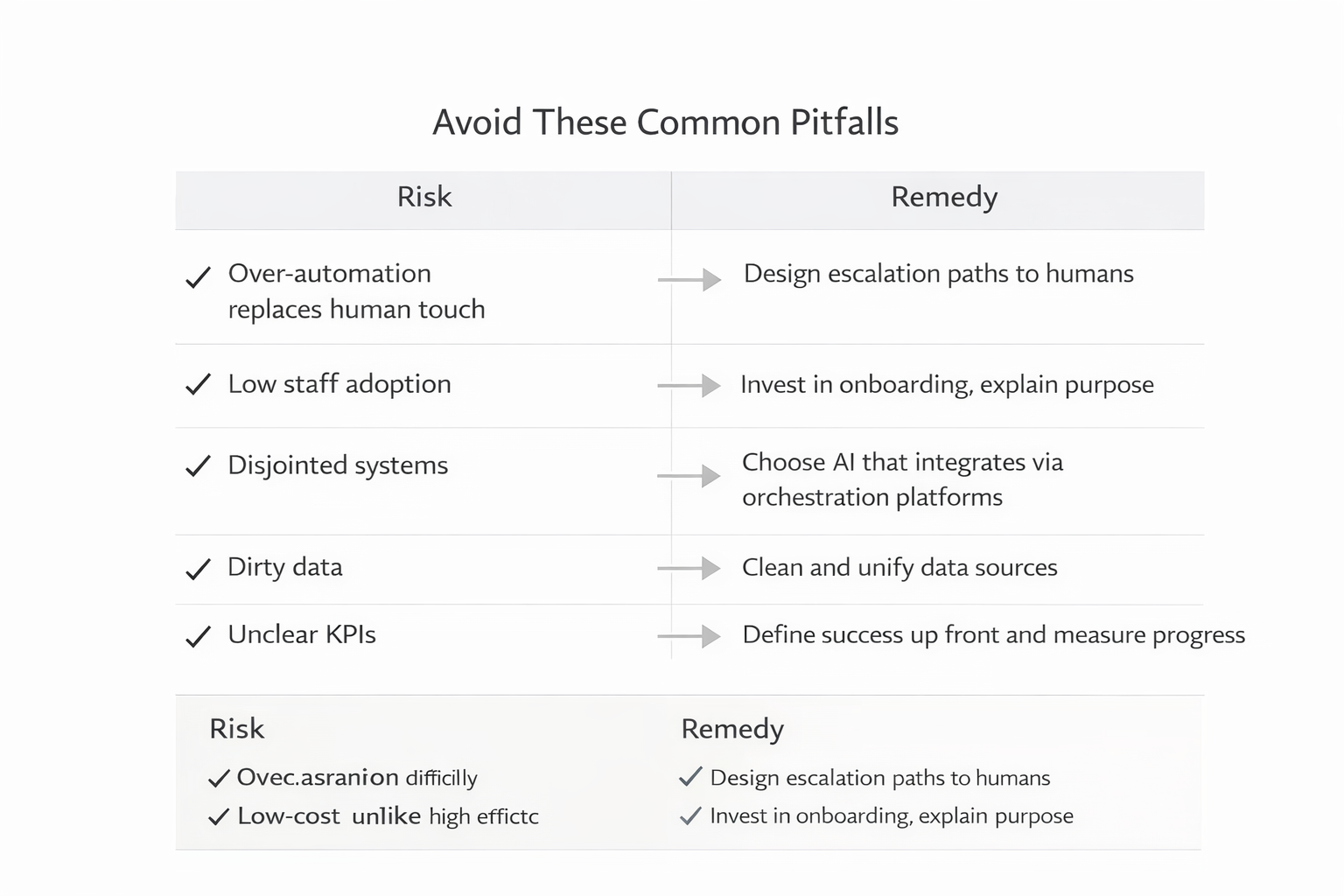
Avoiding Common Pitfalls in Operational AI
When This Approach May Not Fit
- Tasks involve high-trust, emotional decisions (e.g., crisis recovery)
- Your data is inaccessible or disorganized
- The organization lacks the culture or systems for adoption
In such cases, start with foundational improvements or non-AI automation before layering on AI.
Conclusion: The Right AI Strategy Reduces Friction, Not Human Connection
AI doesn’t need to be flashy to be effective. When applied with discipline, it removes friction so your team can focus on hospitality, not firefighting.
By targeting real pain points, testing carefully, and scaling with integration and training, AI becomes a trusted operational ally—not a technology distraction.
Key Takeaways for Business Leaders
- Start with real bottlenecks, not trendy tools
- Use AI to assist—not replace—staff
- Pilot first, then scale with proof and metrics
- Prioritize integration to avoid fragmented systems
- Build staff trust through training and transparency
- Track business impact, not just technical performance
Executive FAQ
How do I know if my business is ready for Operational AI?
If you have high-repetition workflows, usable data, and team interest, you’re likely ready to pilot.
What kind of ROI can I expect?
Case studies report 20–50% time or cost savings in targeted areas, often within 6–12 months.
What roles does AI impact first?
Front-line staff see faster task resolution. Back-office teams benefit from forecasting and automation.
Ready to Reduce Friction in Your Operations?
Sentia Digital helps mid-market operators identify high-impact AI use cases and pilot solutions with low risk and high clarity.
Explore AI Opportunity Assessment →