
From Manual Chaos to Managed Workflows
How practical AI can reduce administrative burden without increasing risk
Executive Summary
Administrative and back-office workflows remain one of the largest — and least visible — cost centers in mid-market organizations.
Manual, fragmented processes drive inefficiency, errors, compliance exposure, and inconsistent experiences for both employees and customers.
Practical, Operational AI — embedded directly into workflows rather than layered on as experiments — allows organizations to move from reactive, manual work to structured, manageable operations.
This article explains where AI realistically fits, where it does not, and how leaders can adopt it safely and incrementally.
What Problem Are Operations Leaders Really Facing?
The Operational Problem
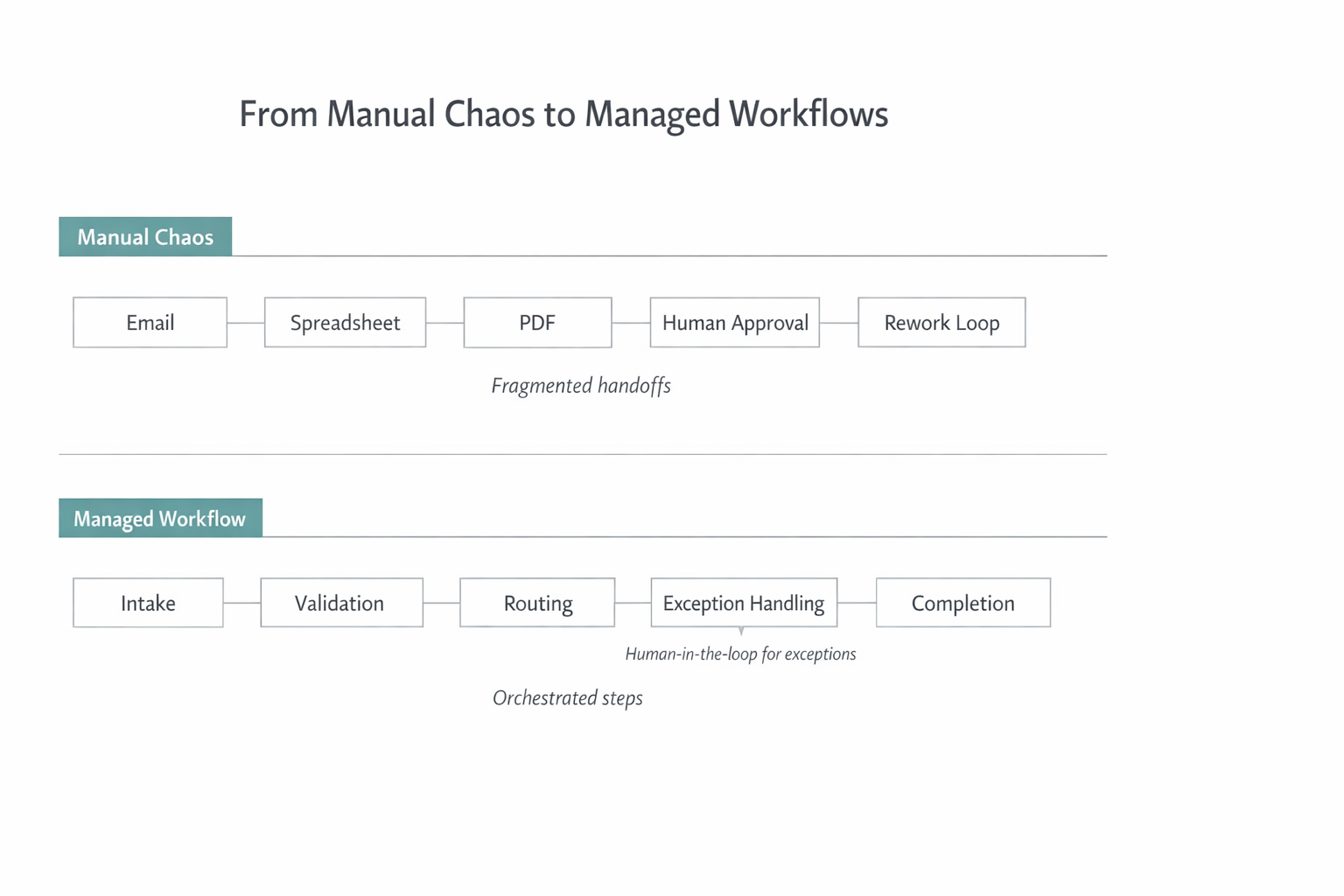
From Manual Chaos to Managed Workflows
At most mid-market organizations, administrative work is not broken — it is simply overloaded.
Common characteristics include:
- Heavy reliance on email, spreadsheets, PDFs, and paper
- Processes that depend on individual memory and informal workarounds
- Approval paths that vary by person, urgency, or historical habit
- Limited visibility into status, ownership, and bottlenecks
As transaction volume increases, exceptions become the norm, not the edge case. What once worked through coordination and goodwill begins to fail under scale.
Key framing for leaders: This is not a people problem or a performance issue. It is a workflow design problem.
Why Does This Matter to the Business?
Efficiency, Cost, Experience, Risk
The cumulative impact of administrative friction shows up across the organization.
Operational efficiency
- Slower cycle times due to manual handoffs
- Frequent rework caused by missing or inconsistent information
- Firefighting instead of predictable execution
Financial impact
- Higher cost per transaction (invoice, claim, request, booking)
- Delayed cash flow and slower revenue realization
- Administrative headcount growing linearly with volume
Customer and employee experience
- Customers experience delays, errors, and inconsistent responses
- Employees spend disproportionate time on low-value, repetitive work
- Burnout increases as teams manage constant exceptions
Risk and compliance exposure
- Manual tracking increases audit risk
- Inconsistent documentation creates regulatory gaps
- Knowledge concentrated in individuals rather than systems
Executive question answered: Why should leadership care now? Because administrative drag quietly erodes margin, trust, and scalability.
Definitions: Key Terms Used in This Article
To keep terminology precise and practical, the following terms are used consistently:
Operational AI — AI embedded into live workflows to automate or assist routine operational tasks, with human oversight.
AI opportunity — A clearly defined workflow step where AI can reduce effort, errors, or decision latency — always tied to a business outcome.
AI pilot — A limited-scope deployment of AI in a real workflow to test value and feasibility before scaling.
Feasibility — A practical assessment of readiness based on data quality, systems integration, compliance constraints, and change capacity.
Orchestration — The coordination of systems, AI components, rules, and people into an end-to-end operational workflow.
How Does AI Actually Apply in Practice?
Explained Simply and Practically
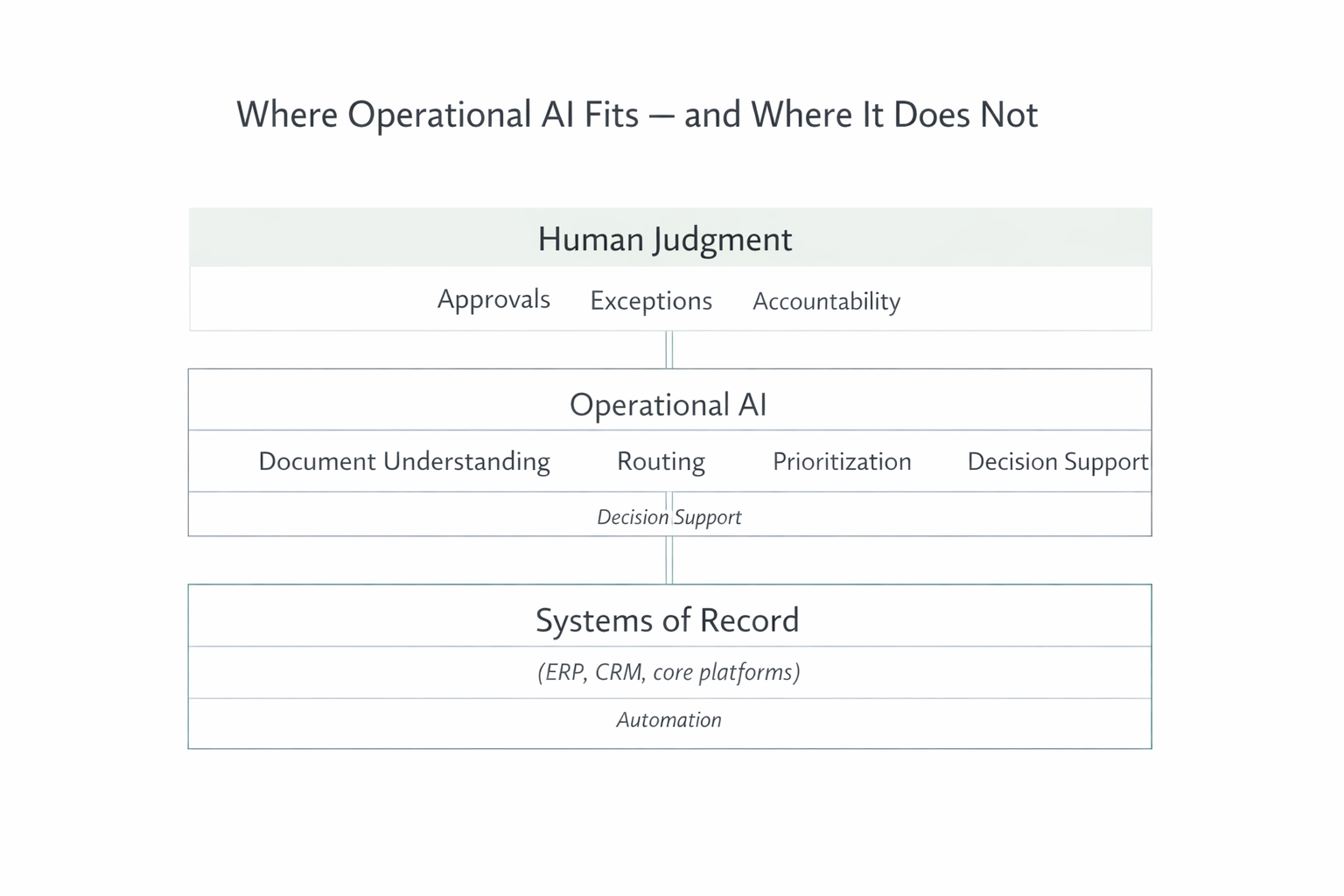
Where Operational AI Fits — and Where It Does Not
The most successful AI deployments share one trait: they support workflows instead of replacing people.
Where AI fits best
- High-volume, repeatable administrative steps
- Document-heavy processes
- Tasks involving validation, routing, prioritization, or summarization
What AI does in these workflows
- Extracts and structures information from documents
- Routes work to the correct queue or role
- Flags exceptions and missing data
- Provides decision support and recommendations
What AI does not do
- Make final clinical, legal, or high-stakes decisions
- Operate without oversight
- Replace accountability or professional judgment
What Does This Look Like in the Real World?
Examples from Non-Tech Industries
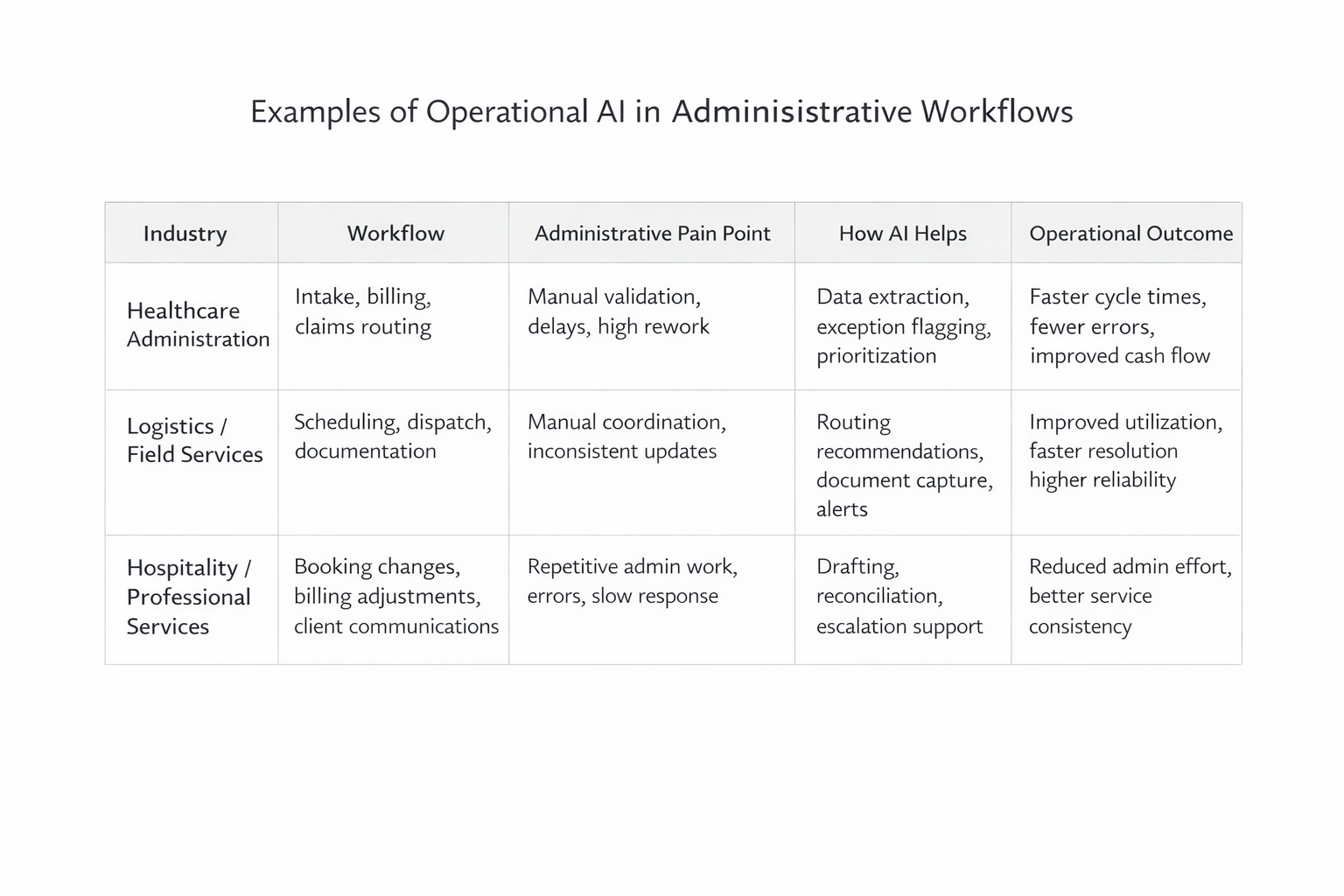
Examples of Operational AI in Administrative Workflows
Healthcare Administration
- Intake, billing, and claims routing supported by AI-assisted validation
- AI prioritizes exceptions; staff retain approval authority
Logistics & Field Services
- Scheduling, dispatch, and documentation supported by AI recommendations
- Human operators confirm and adjust plans
Hospitality & Professional Services
- Booking changes, billing reconciliation, and client communications
- AI drafts, reconciles, and escalates — staff finalize
Shared pattern: These are operational improvements, not experimental or customer-facing risks.
How Should Companies Get Started?
A Safe, Phased Implementation Approach
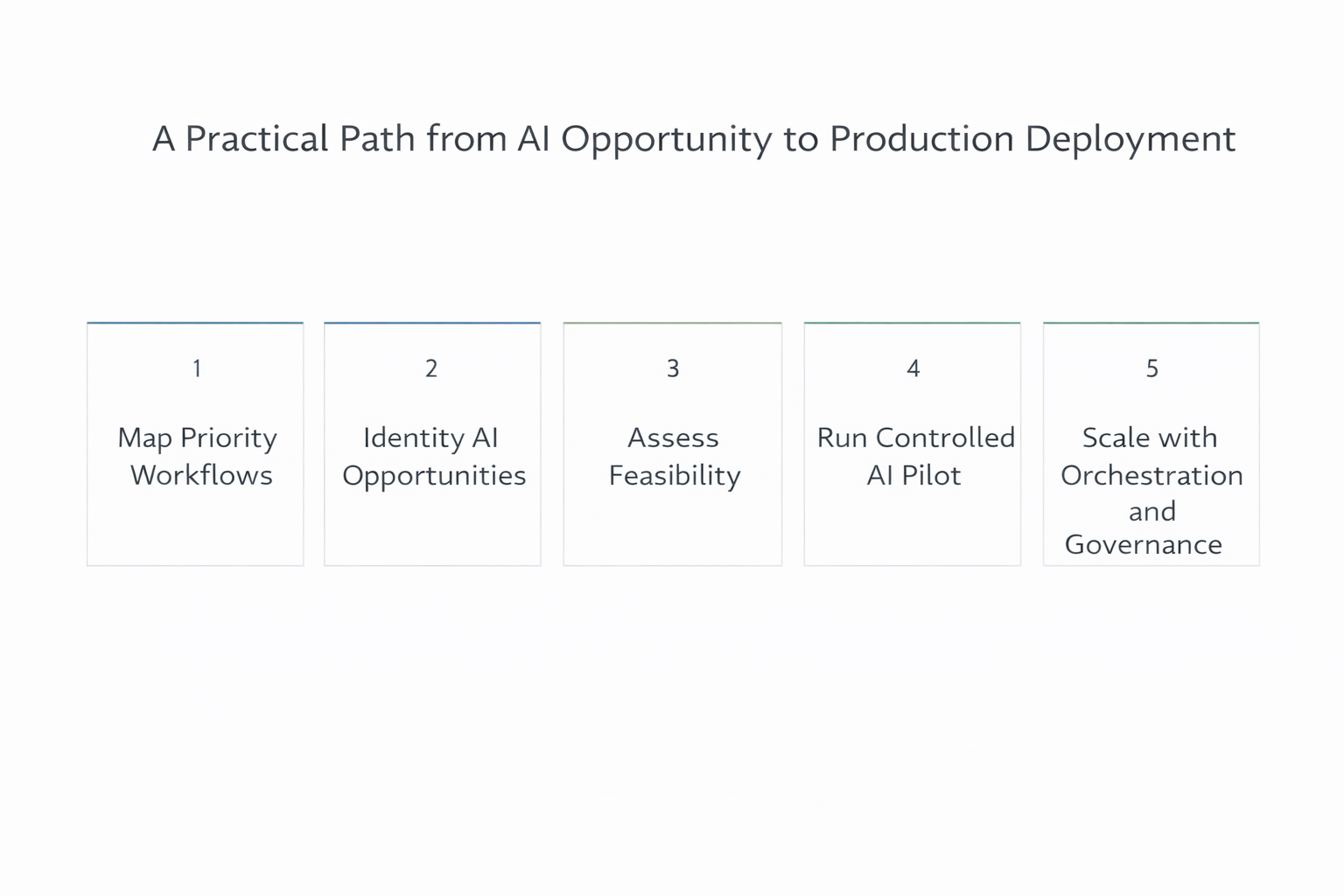
A Practical Path from AI Opportunity to Production Deployment
A disciplined sequence reduces risk and builds confidence.
Map priority workflows
Identify high-friction administrative processes that consume time and attention.
Identify AI opportunities
Focus on steps that are repetitive, document-driven, or exception-heavy.
Assess feasibility early
Evaluate data quality, system integration, compliance, and change readiness.
Run a controlled AI pilot
Keep scope narrow. Measure cycle time, error reduction, and throughput.
Scale with orchestration and governance
Integrate into systems of record with monitoring and human oversight.
When Is This Approach Not Appropriate?
Important Boundaries Leaders Should Understand
Operational AI is not a universal solution.
It may not be appropriate for:
- Highly subjective or creative work with no consistent patterns
- Processes with unreliable or missing data
- High-stakes decisions requiring full human accountability
- Organizations unwilling to redesign workflows or manage change
What Should Leaders Watch Out For?
Common Pitfalls and How to Avoid Them
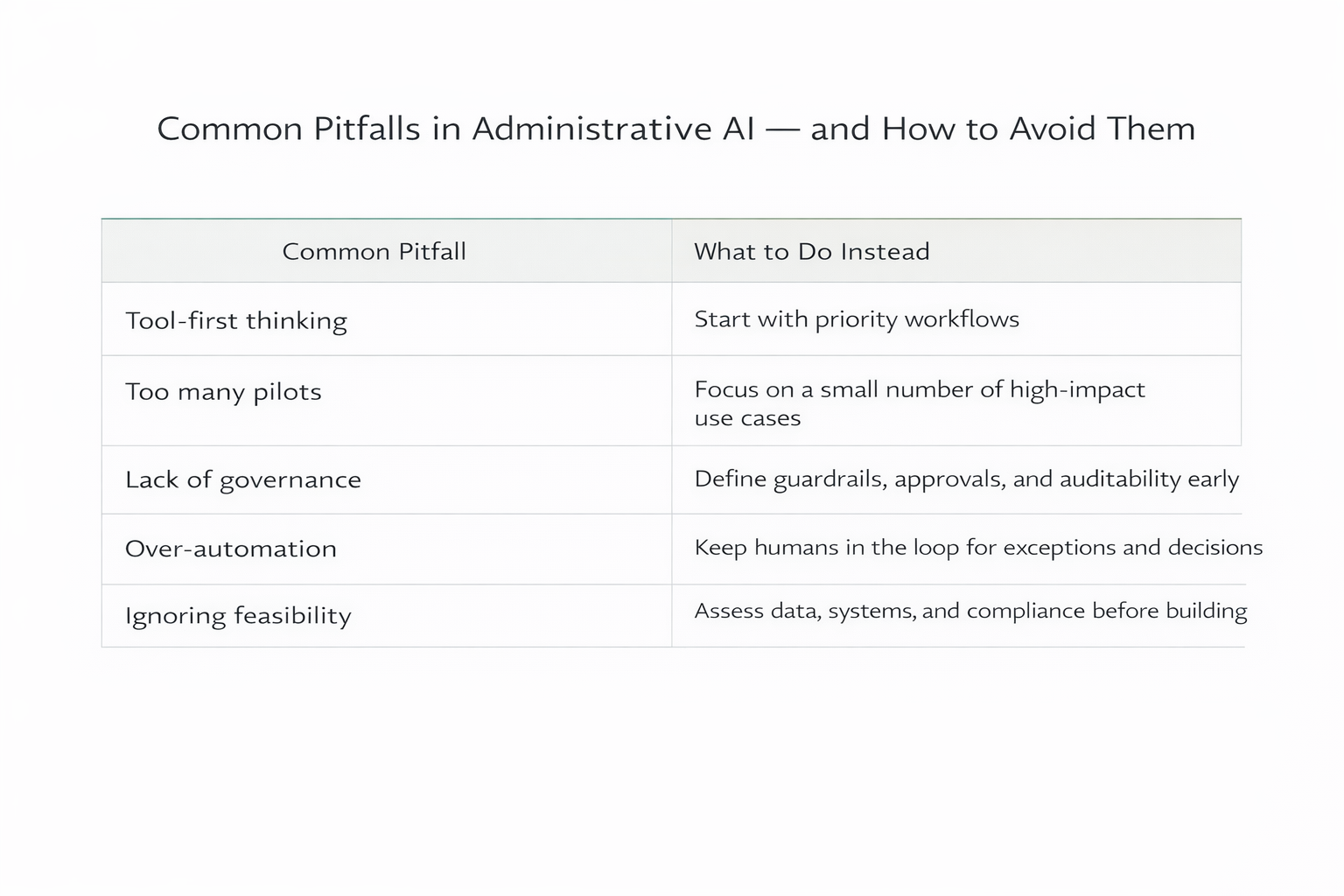
Common Pitfalls in Administrative AI — and How to Avoid Them
Buying tools before defining workflows — Start with the business problem, not the vendor.
Running too many disconnected pilots — Focus on one or two pilots with production intent.
Ignoring governance and auditability — Design escalation paths and oversight from day one.
Underestimating change management — Involve users early and explain intent clearly.
Over-automating without human-in-the-loop controls — Use AI to assist before it decides autonomously.
Each can be mitigated with workflow-first design and disciplined execution.
Closing: A Practical Next Step for Leaders
Moving from manual chaos to managed workflows does not require hype or wholesale transformation. It requires clarity, prioritization, and operational discipline.
Organizations that succeed treat AI as an operational capability, not a side project. Sentia Digital supports this journey through its AI Opportunity Assessment, helping leaders identify feasible, high-impact use cases and design responsible pilots that deliver measurable results.
Key Takeaways for Business Leaders
- Administrative workflows are a major cost center that AI can address — without high risk
- AI works best when it supports workflows, not when it replaces human judgment
- Start with high-friction, document-heavy processes
- A phased approach reduces risk and builds organizational confidence
- Workflow-first design prevents common pitfalls
Ready to Transform Your Operations?
Reduce administrative friction and improve operational reliability — without increasing risk.
Explore AI Opportunity Assessment →