From Paperwork to Throughput: How AI Becomes Operational Infrastructure in Education Administration
Practical ways mid-market education organizations reduce administrative drag without risking trust, compliance, or culture.
Executive Summary
Education administrators are under sustained pressure from paperwork-heavy workflows, fragmented systems, and rising compliance demands. While AI is often discussed in instructional or experimental terms, its most immediate and reliable value lies in administrative operations.
When applied as Operational AI, AI improves speed, accuracy, and reliability across core workflows while keeping humans in control.
What Problem Are Education Leaders Actually Facing?
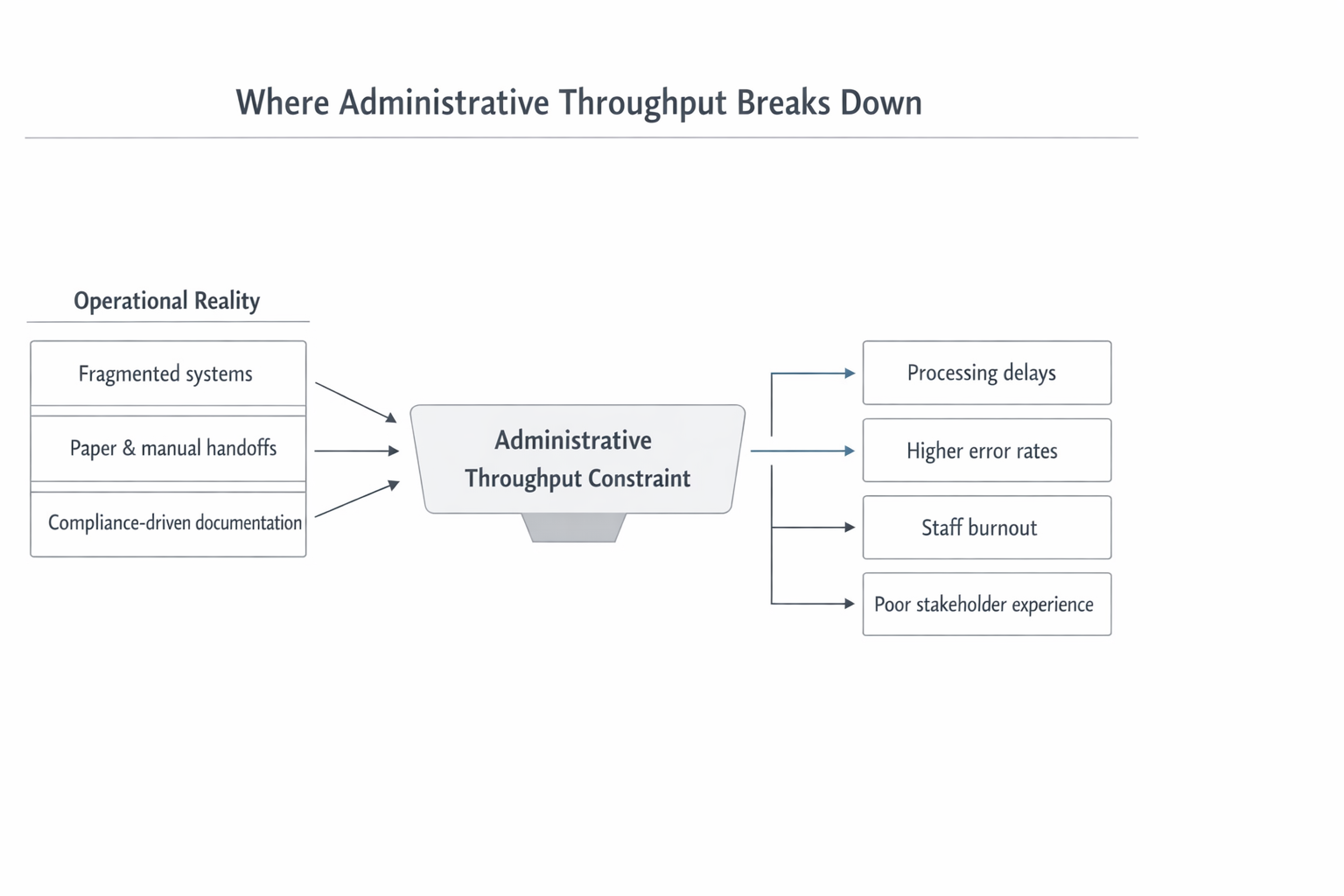
Where Administrative Throughput Breaks Down
Administrative operations in education are not failing because staff are ineffective. They are failing because the system limits throughput.
Across K–12 districts, colleges, and universities, administrative teams manage admissions, records, scheduling, compliance reporting, HR administration, finance operations, and ongoing communication with students, parents, and staff. Many of these workflows still rely on:
- Manual data entry
- Paper or PDF-based documents
- Email handoffs between teams
- Disconnected systems that do not share data well
The outcome is predictable. Even highly capable teams struggle to keep up. Applications wait in queues. Transcript requests take weeks. Reports are assembled manually under deadline pressure.
This is not a performance issue. It is a throughput issue—where the volume of work exceeds what manual systems can process reliably.
Why Does This Matter to Executives?
Efficiency
Highly skilled staff are spending time on low-value work. Every hour spent re-entering data or managing documents is an hour not spent improving student services, supporting faculty, or planning strategically.
Cost
Manual processes scale linearly with headcount. When volume increases, organizations hire more staff instead of improving flow. Administrative overhead grows faster than instructional investment.
Experience
Students and parents experience slow responses, inconsistent communication, and unclear processes. In higher education, slow admissions and financial aid processing directly affects enrollment yield and retention.
Risk and Compliance
Education is a compliance-heavy environment. Attendance reporting, funding documentation, accreditation data, and student records must be accurate and timely. Manual reporting increases audit risk and the likelihood of errors that can affect funding.
Executive takeaway: Administrative throughput affects cost structure, growth capacity, risk exposure, and stakeholder trust.
Definitions: Clarifying Key Terms
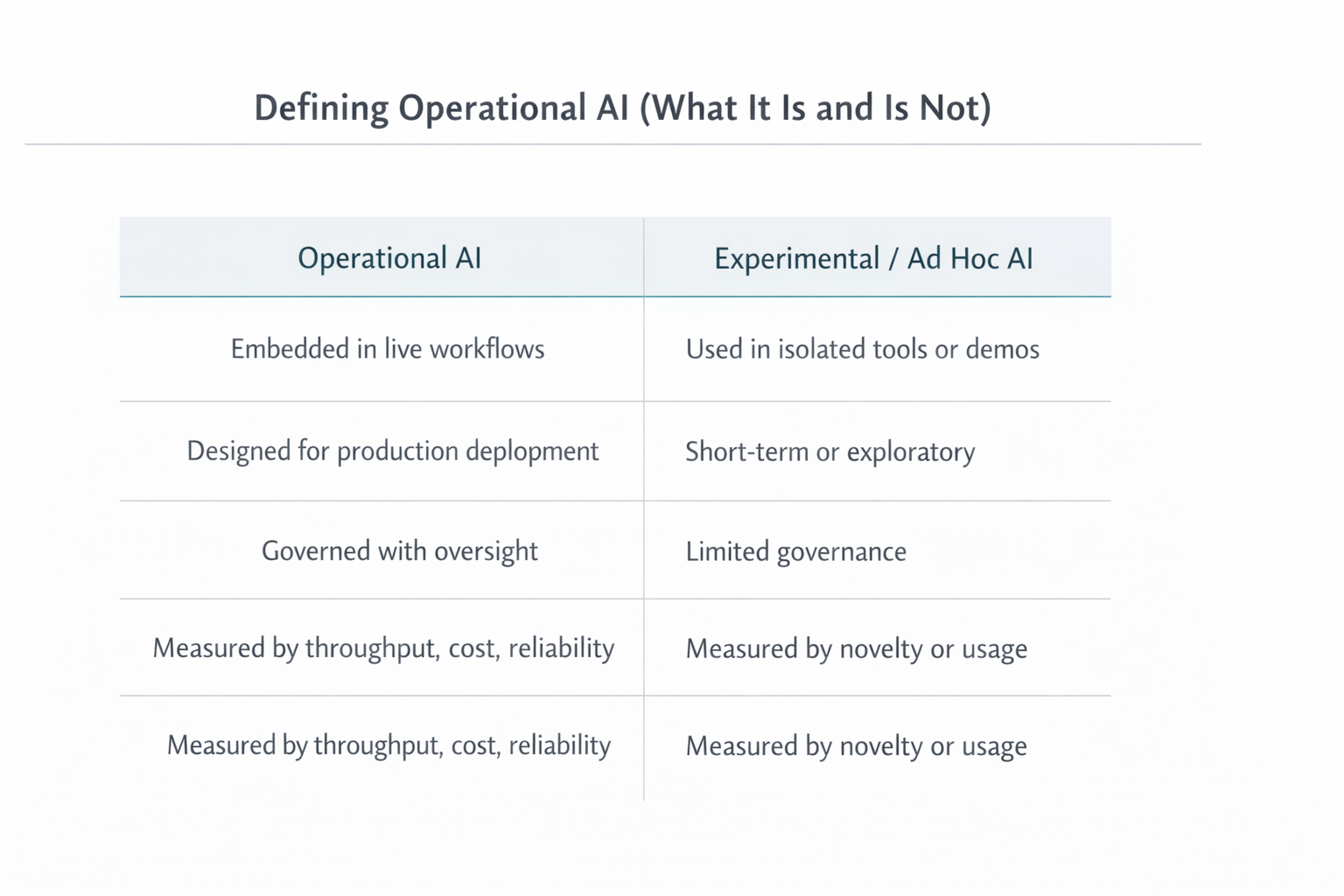
Defining Operational AI — What It Is and Is Not
Operational AI — AI systems embedded into live business workflows to improve speed, accuracy, or reliability. Designed for production use, monitored over time, and governed with clear oversight.
AI Opportunity — A specific workflow or decision point where AI can measurably improve outcomes such as processing time, error rates, or cost.
AI Pilot — A controlled, limited-scope deployment using real data and real users to validate value and feasibility before scaling.
Feasibility — The practical likelihood that a use case can succeed given data quality, system integration, governance requirements, and organizational readiness.
Orchestration — The coordination of AI tools, existing systems, and human workflows so that AI outputs lead to action rather than isolated insights.
These distinctions matter because many AI initiatives fail when experimentation is mistaken for infrastructure.
How Does AI Apply in Practice Without the Hype?
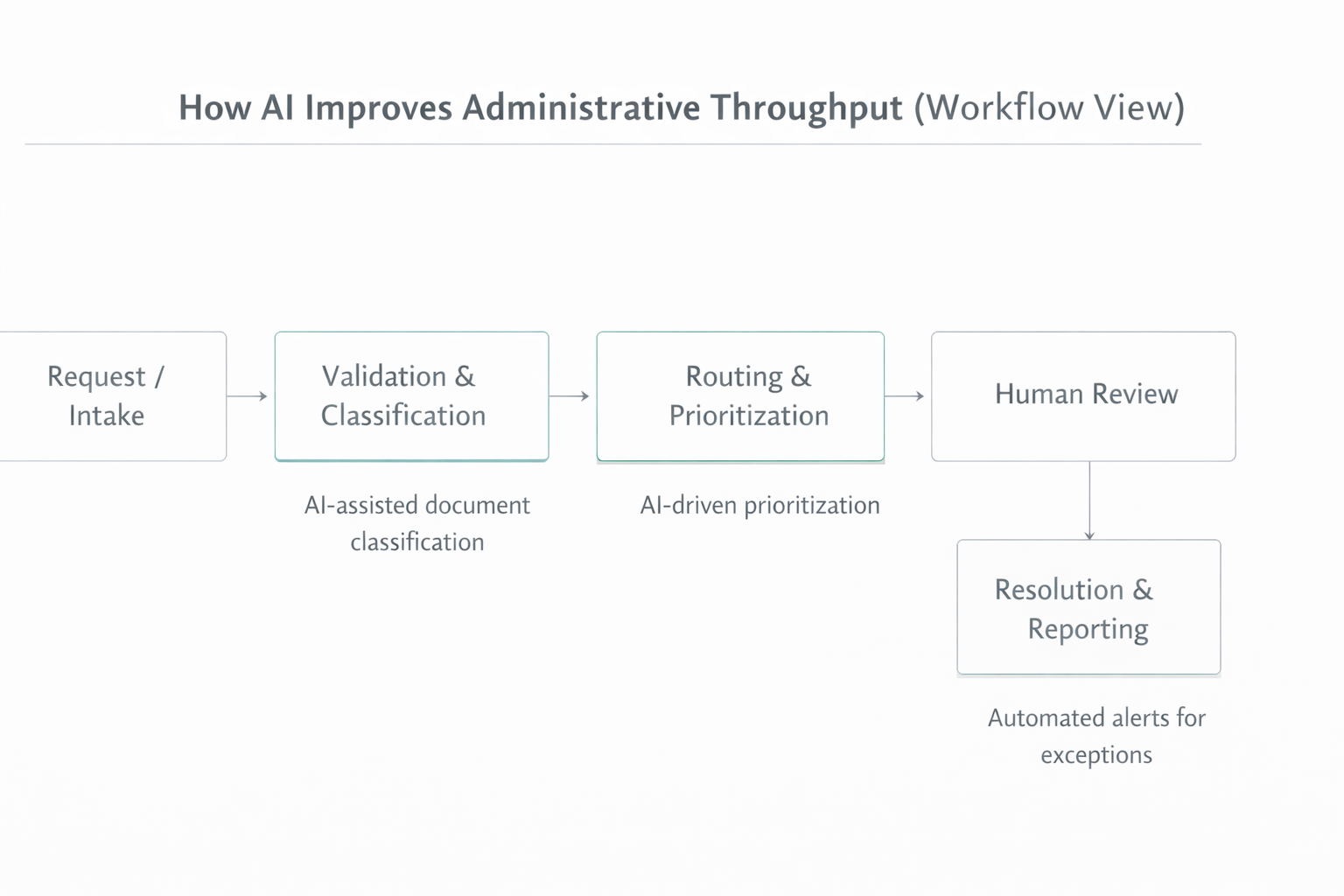
How AI Improves Administrative Throughput — Workflow View
In education administration, AI works best when it handles volume and repetition, not judgment.
Practical applications focus on a small number of capabilities:
- Document intake and classification
- Data extraction and validation
- Forecasting and alerts
- Workflow routing and prioritization
Instead of staff manually opening emails, downloading attachments, and entering data, AI can classify incoming documents, extract key fields, and route cases to the correct queue. Humans review exceptions and make decisions where context matters.
The human remains accountable. The system simply moves faster.
Higher Education Marketing reports that AI-based automation can reduce administrative processing time by 20 to 40% when applied to document-heavy workflows such as admissions and records management.
This is not about novelty tools. It is about improving flow across real operational processes.
What Does This Look Like in Other Slow-Adoption Industries?
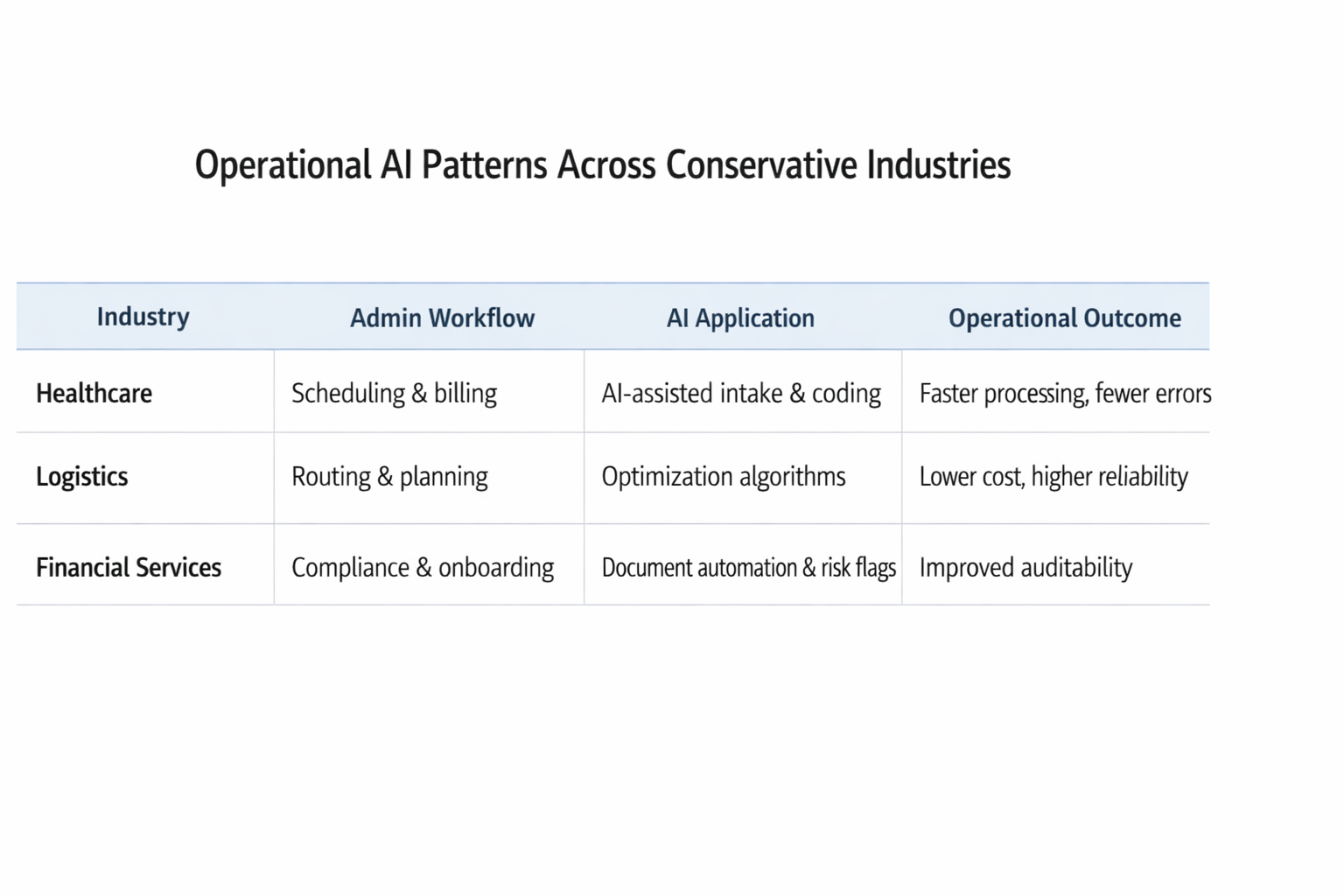
Operational AI Patterns Across Conservative Industries
Education is not unique in facing these challenges.
Administrative Burden Reduction
Hospitals operate under heavy documentation and compliance requirements. AI supports scheduling, billing, and documentation while preserving clinical oversight.
Route & Schedule Optimization
Boston Public Schools applied optimization techniques to bus routing, reducing fleet size and improving efficiency.
Document Processing & Onboarding
Banks use AI for document processing, onboarding, and compliance checks—workflows that closely resemble admissions and records processing.
The common thread is clear. AI succeeds in regulated, risk-sensitive environments when it supports operations rather than replacing judgment.
Where AI Is Most Effective in Education Administration
AI delivers the most value where workflows share consistent characteristics.
Strong-fit use cases include:
- Admissions and enrollment processing
- Transcript and records management
- Attendance tracking and reporting
- Scheduling and resource allocation
- Compliance documentation
- Internal FAQs and routine communications
These workflows are typically high volume, rules-driven, repeatable, and suitable for human review at defined checkpoints.
Edutopia highlights how AI-assisted drafting and summarization tools have reduced time spent on legally required paperwork such as individualized education program documentation, while keeping educators responsible for final content.
When This Approach May Not Be Appropriate
AI is not a universal solution.
Poor-fit scenarios include:
- Low-volume, highly bespoke decisions
- Workflows without clear ownership
- Environments with weak data hygiene
- Use cases with unresolved ethical or policy concerns
A key warning sign is expecting AI to fix cultural or organizational issues. AI amplifies well-designed systems. It does not repair broken ones.
How Should Leaders Implement This Responsibly?
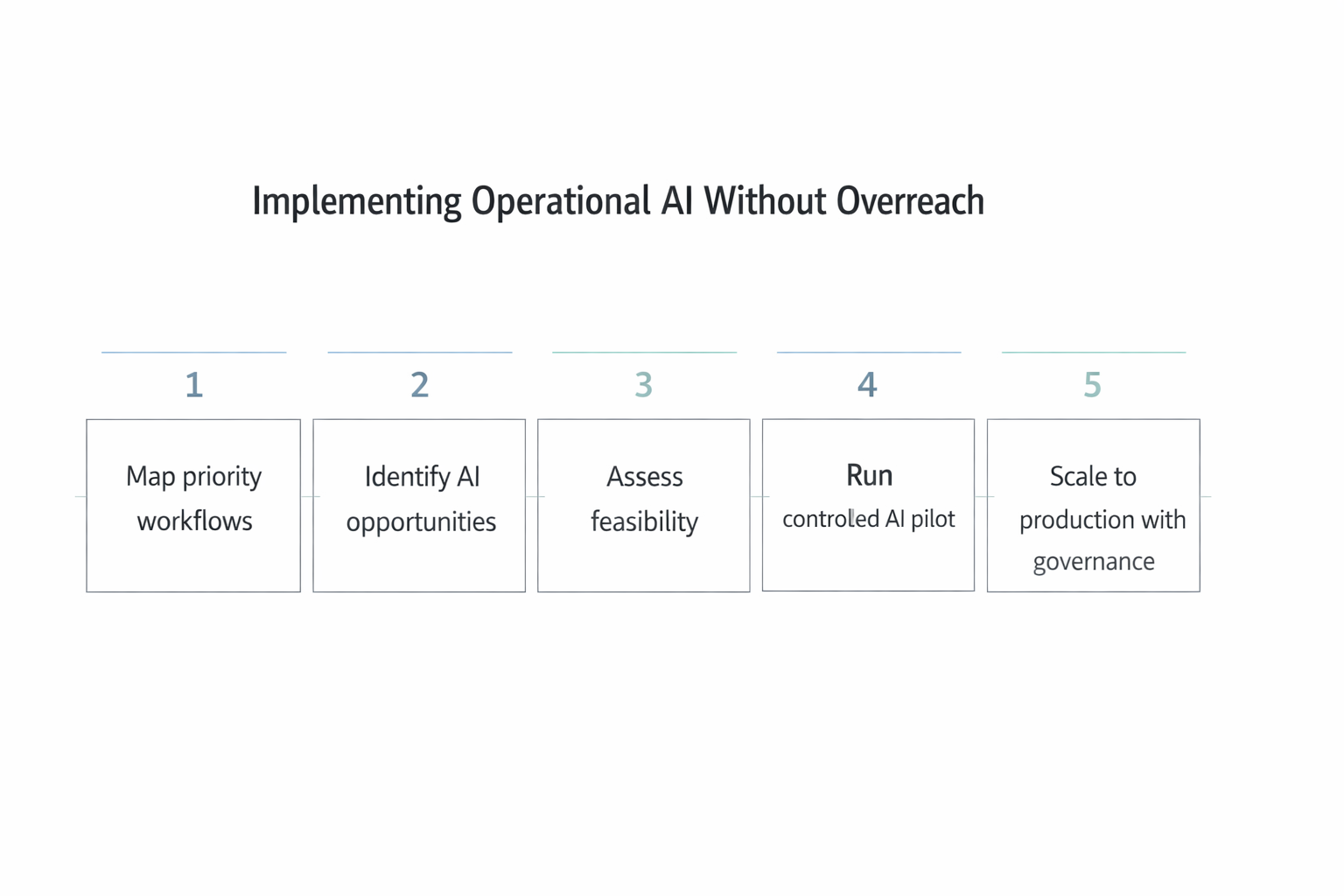
Implementing Operational AI Without Overreach
A responsible implementation follows a disciplined sequence.
Map priority workflows
Identify where time, errors, or delays concentrate.
Identify AI opportunities
Focus on throughput improvement, not transformation narratives.
Assess feasibility
Review data quality, integration needs, governance, and adoption readiness.
Run a controlled AI pilot
Use real data and real users with clear success metrics.
Scale to production with governance
Ensure monitoring, ownership, and auditability are in place.
Indianapolis Public Schools followed this approach by piloting AI tools with a limited group of staff before expanding usage, allowing policy and governance to mature alongside adoption.
What Pitfalls Should Executives Watch Out For?
Common pitfalls include tool-first thinking without workflow clarity, underestimating data cleanup and integration effort, ignoring staff training and adoption, treating pilots as endpoints, and weak governance around sensitive data.
How to avoid them: Anchor initiatives to workflow owners. Define success metrics early. Communicate clearly that AI supports staff rather than replaces them. Invest in orchestration rather than isolated tools.
Executive FAQ
Does AI require replacing existing systems?
No. Most value comes from integrating AI into current systems and workflows.
How long does it take to see results?
Well-scoped pilots often show measurable improvements within weeks.
Is this risky from a compliance standpoint?
Risk is reduced when AI is governed, monitored, and used with human oversight.
Key Takeaways for Business Leaders
- Administrative throughput is now a strategic constraint in education organizations
- AI delivers the most value when embedded into real workflows, not used as standalone tools
- Operational AI improves speed and accuracy while preserving human accountability
- Start with high-volume, repeatable administrative processes
- Pilot responsibly, govern carefully, and scale only when feasibility is proven
Ready to Reduce Administrative Drag?
Sentia Digital helps education organizations identify practical, low-risk AI use cases aligned to real operations.
Start the Conversation →