Operational AI in Procurement: Moving Beyond Static Scorecards
How mid-market organizations improve supplier visibility, reduce risk, and increase consistency through continuous, data-driven evaluation embedded directly into day-to-day workflows.
Executive Summary
Many procurement teams still rely on static, spreadsheet-based supplier scorecards that offer delayed and incomplete insight into supplier performance. This approach creates operational blind spots, drives hidden costs, and increases risk exposure across sourcing, inventory, and compliance.
Operational AI enables procurement leaders to move from periodic reviews to continuous, data-driven evaluation embedded directly into day-to-day workflows. This article explains how that shift works in practice, where AI delivers real value (without hype), and how mid-market organizations can adopt it responsibly.
Key Terms Used in This Article
- Operational AI — AI systems embedded into live procurement workflows that operate continuously in production, rather than as isolated analytics or experimental tools.
- AI Opportunity — A clearly defined operational problem where AI can deliver measurable improvement compared to manual or rules-based approaches.
- AI Pilot — A controlled, limited-scope implementation used to validate feasibility, data readiness, and value before scaling.
- Production Deployment — An AI system running reliably within core procurement processes, supported by monitoring, governance, and human oversight.
- Feasibility — The practical ability to implement a use case given data quality, system integration requirements, organizational readiness, and risk constraints.
- Orchestration Platform — Technology that coordinates data flows, AI models, approvals, and system actions across procurement workflows.
The Operational Problem: Why Procurement Still Runs on Static Scorecards
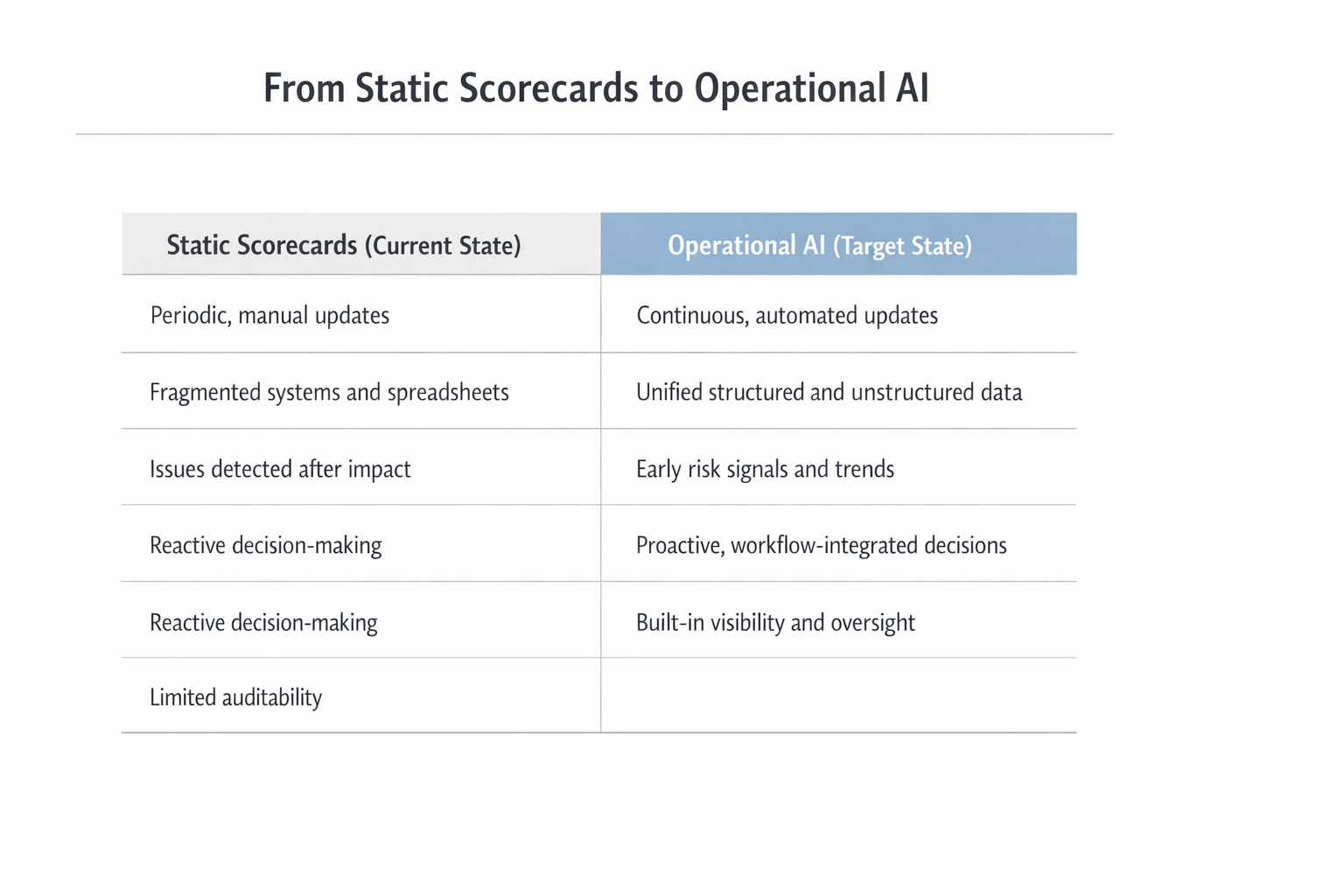
From Static Scorecards to Operational AI
Despite growing complexity in supply chains, supplier performance is still commonly evaluated:
- Monthly or quarterly
- Manually, using spreadsheets
- After issues occur, not before
Most scorecards rely on lagging indicators pulled from fragmented systems—ERP, logistics, quality, and accounts payable—then stitched together by hand.
As a result:
- Supplier issues surface only after they disrupt operations
- Procurement teams spend time compiling reports instead of managing risk
- Decision-making remains reactive, not anticipatory
This model persists in many mid-market organizations due to legacy systems, limited analytics capacity, and the assumption that “scorecards are good enough.”
Why This Matters: Operational, Financial, and Risk Implications
Static supplier evaluation affects far more than reporting—it directly impacts performance.
Operational Efficiency
- Late detection of delivery delays, quality degradation, and capacity constraints
- Increased firefighting and exception handling across teams
Financial Performance
Cost leakage can come from:
- Pricing and invoicing errors
- Missed discounts and contract terms
- Excess inventory used as a buffer against uncertainty
Manual workflows also drive a higher cost per transaction.
Risk and Compliance
- Weak early warning for supplier distress or compliance failures
- Limited auditability of supplier-related decisions
Strategic Impact
- Procurement positioned as transactional rather than strategic
- Oversight does not scale as supplier networks grow more complex
How AI Applies: What This Looks Like in Practice
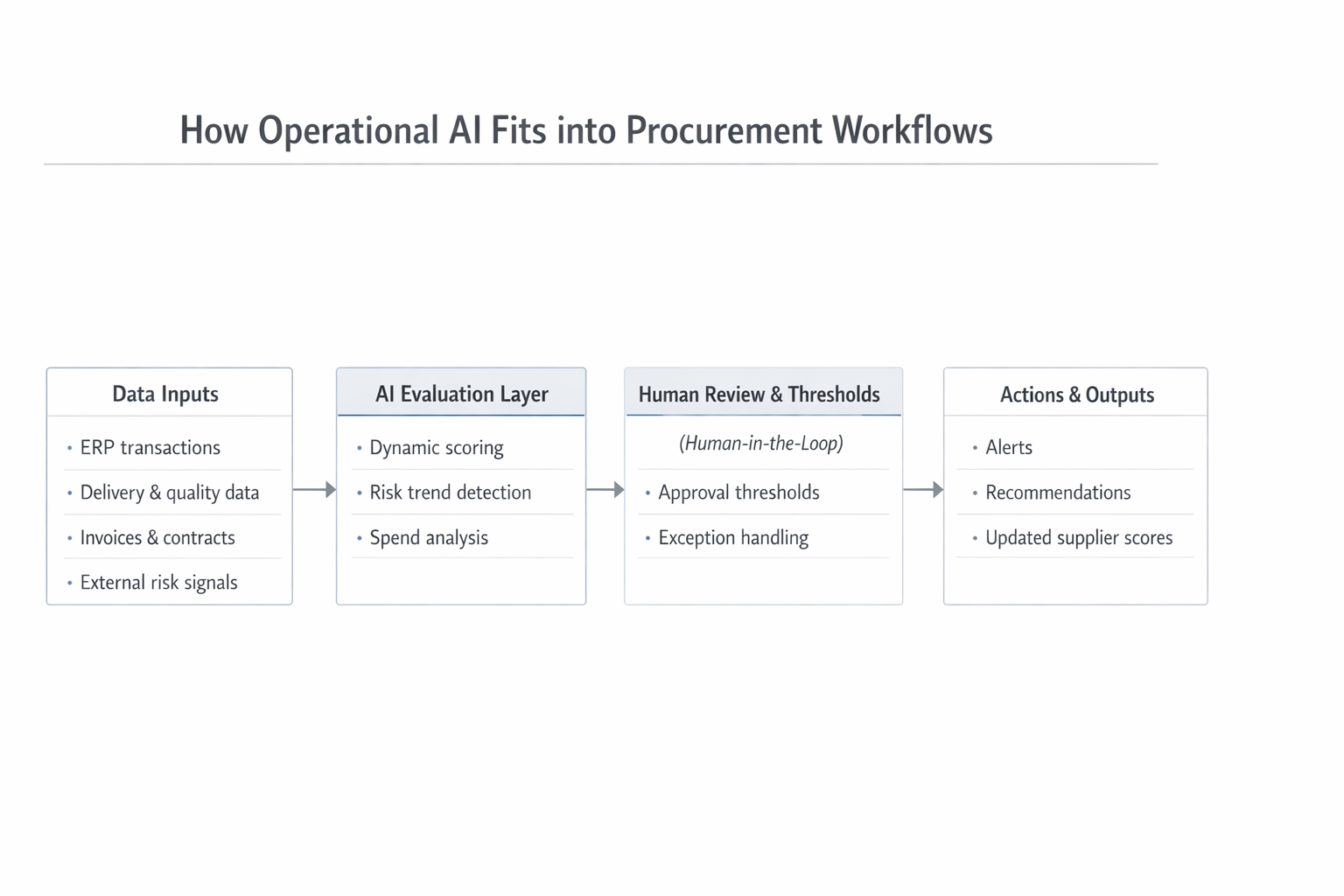
How Operational AI Fits into Procurement Workflows
The shift enabled by Operational AI is straightforward in concept, even if powerful in impact.
Instead of reviewing supplier performance periodically, AI enables continuous monitoring by ingesting data as it is created, including:
- ERP and purchasing transactions
- Delivery and quality metrics
- Invoices and contract data
- External risk signals (where appropriate)
AI models analyze patterns and trends, not just static thresholds. Insights are then surfaced inside existing workflows through alerts, dashboards, and decision recommendations.
Humans remain accountable. AI supports decisions; it does not replace them.
Realistic Operational Examples from Non-Tech Industries
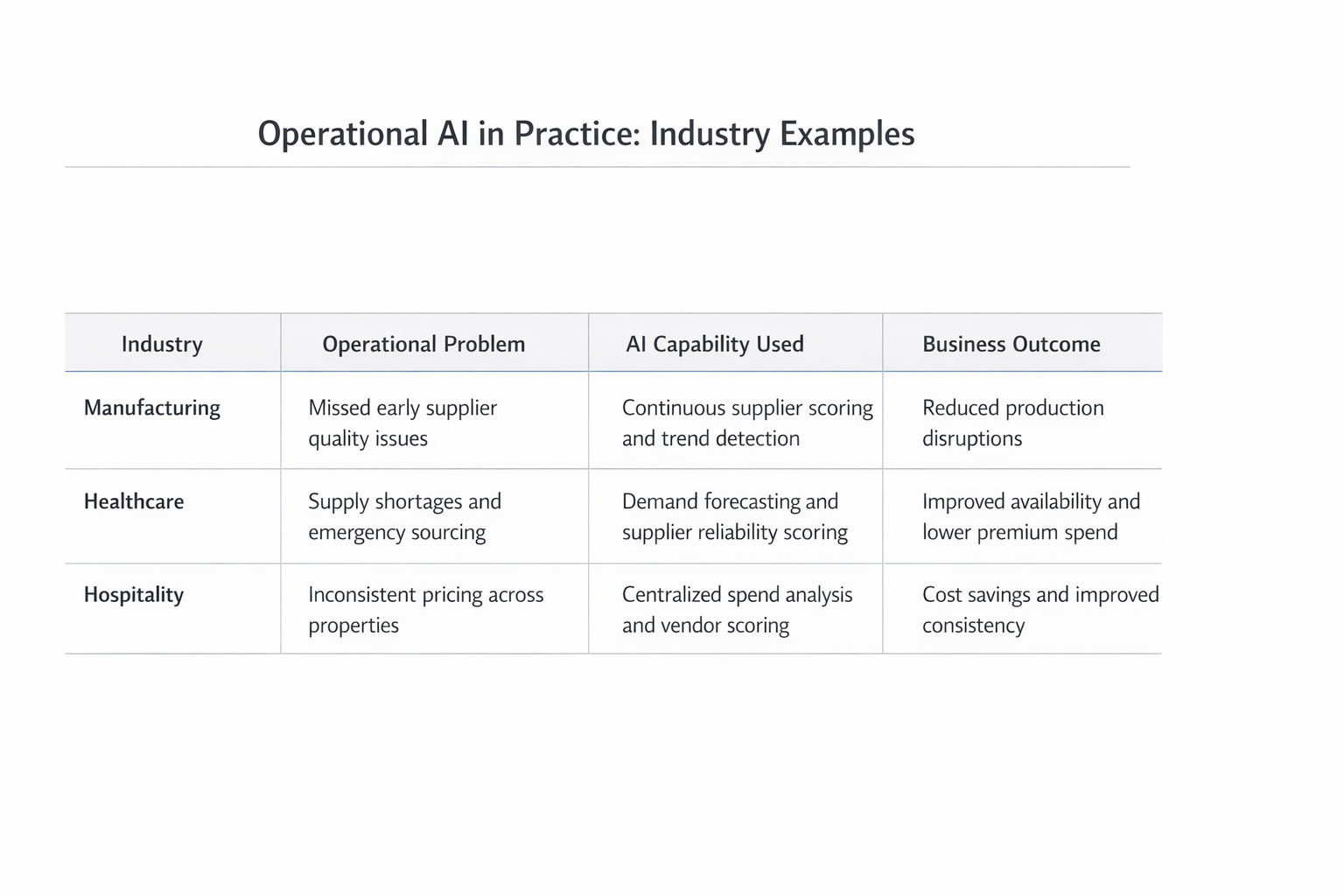
Operational AI in Practice—Industry Examples
Manufacturing Supplier Risk Monitoring
Challenge: Quarterly reviews missed early quality degradation.
AI application: Continuous tracking of defect rates and delivery trends.
Healthcare Supply Procurement
Challenge: Static par levels led to shortages and emergency sourcing.
AI application: Demand forecasting combined with supplier reliability scoring.
Hospitality Multi-Property Purchasing
Challenge: Decentralized buying created inconsistent pricing and vendor performance.
AI application: Centralized spend analytics and supplier scoring.
Recommended Implementation Steps
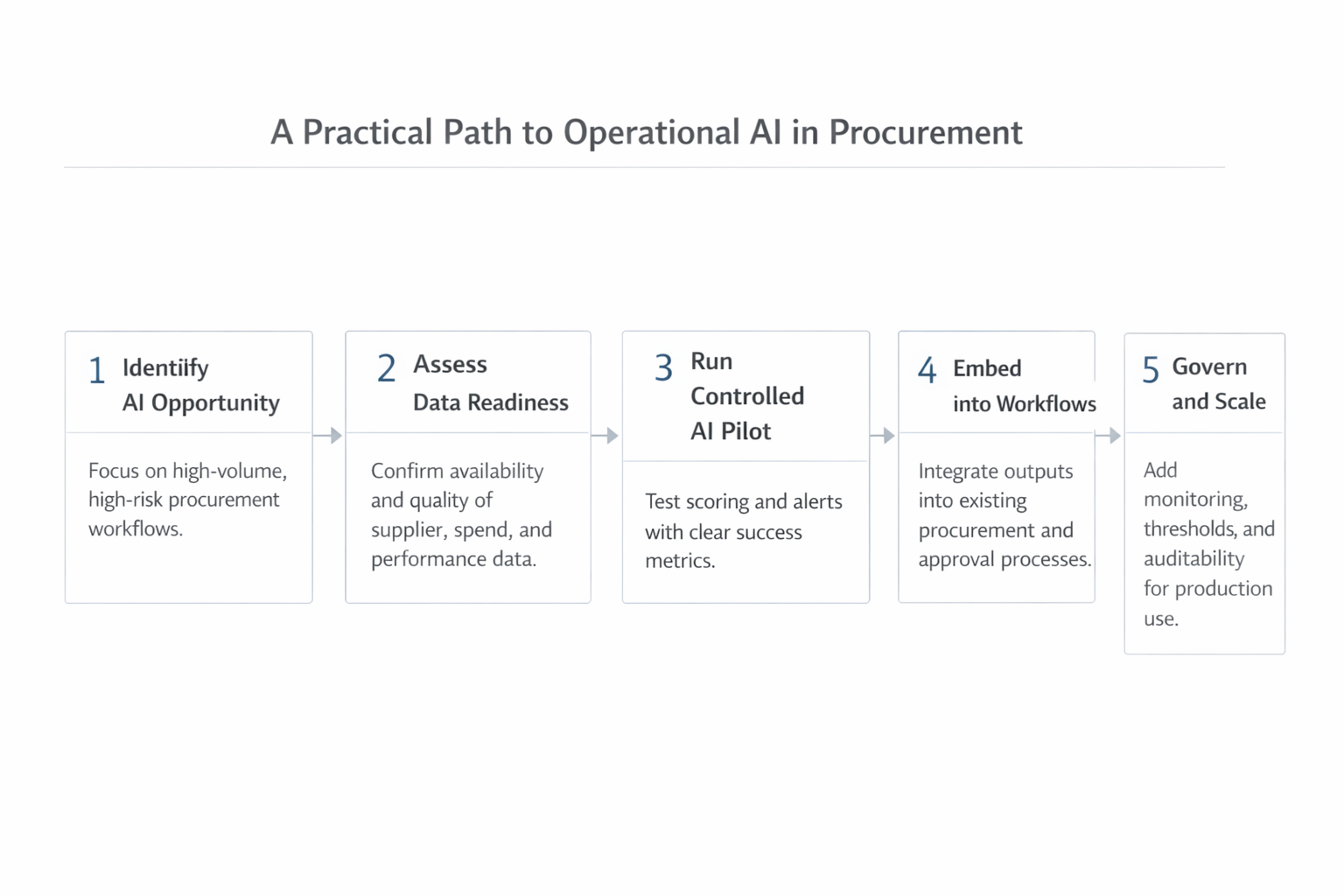
A Practical Path to Operational AI in Procurement
A disciplined approach reduces risk and accelerates value.
Identify the AI opportunity
Focus on high-volume or high-risk supplier decisions.
Assess data readiness
Inventory existing data sources; start with what is available.
Run a controlled AI pilot
Limit scope to one category, region, or supplier segment.
Embed into workflows
Integrate with ERP and procurement systems; keep humans in the loop.
Establish governance and scale
Define ownership, thresholds, and auditability before expanding.
Common Pitfalls: What Leaders Should Watch Out For
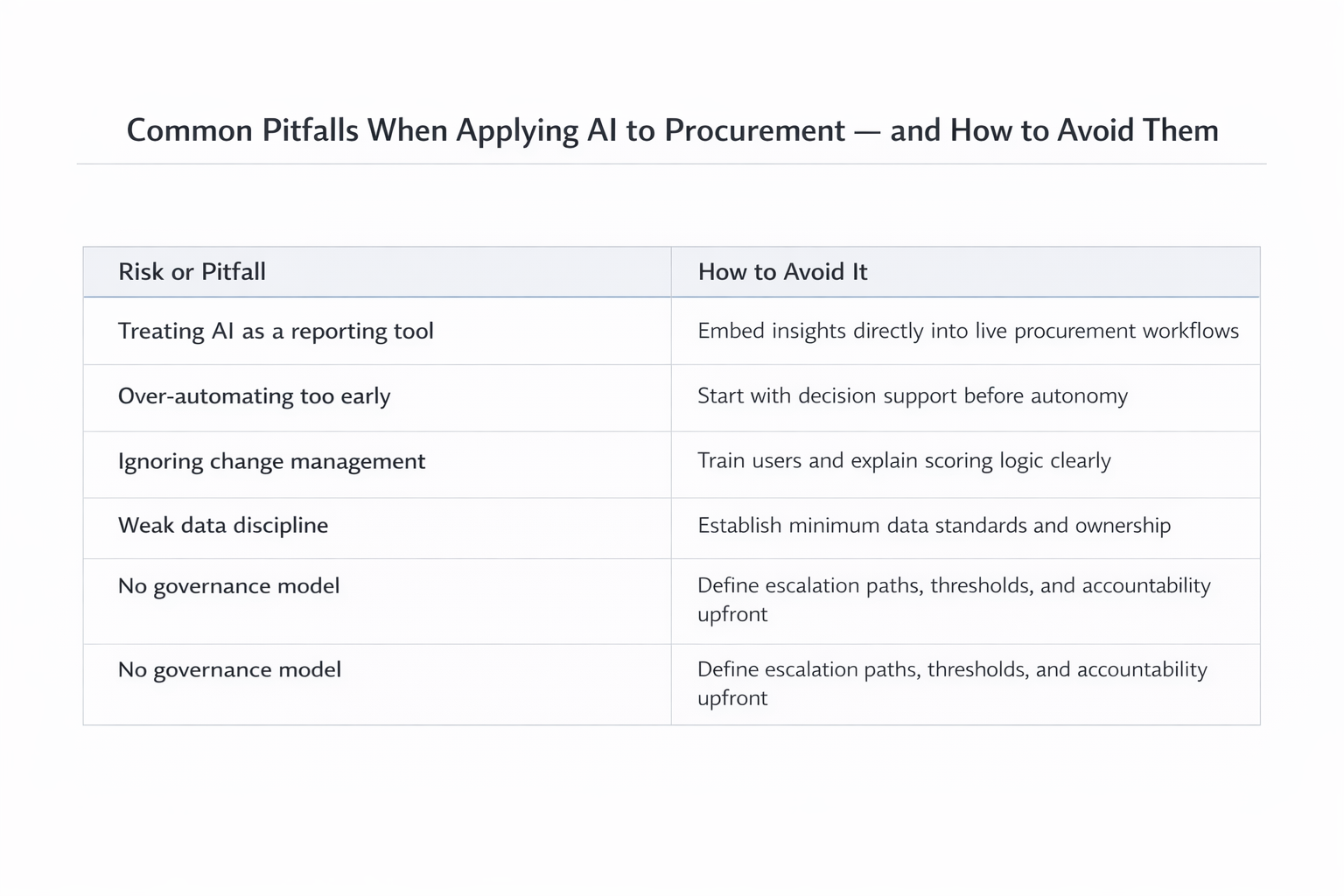
Common Pitfalls When Applying AI to Procurement—and How to Avoid Them
- Treating AI as a reporting tool — Embed insights directly into decisions and workflows.
- Over-automating too early — Start with decision support, not autonomy.
- Ignoring change management — Train users and explain scoring logic clearly.
- Weak data discipline — Establish minimum data standards and ownership.
- No governance model — Define escalation paths and accountability upfront.
When This Approach May Not Be Appropriate
Operational AI is not always the right answer. It may be a poor fit when:
- Supplier ecosystems are very small and stable
- Procurement data is largely undigitized
- The organization is unwilling to adjust workflows or decision rights
- Simple rules-based automation is sufficient
- Regulatory requirements mandate fully manual review
Key Takeaways for Procurement Leaders
- Static scorecards create operational blind spots, hidden costs, and risk exposure
- Operational AI enables continuous supplier evaluation embedded into daily workflows
- AI supports decisions—humans remain accountable
- Start with a controlled pilot focused on high-volume or high-risk decisions
- Governance, data discipline, and change management are essential for success
Ready to Move Beyond Static Scorecards?
Sentia Digital helps procurement leaders identify feasible AI use cases, design controlled pilots, and move responsibly toward production deployment.
Start an AI Opportunity Assessment →