
Where AI Pays Off First and Where It Rarely Does in Mid-Market Companies
A practical, operations-first view of AI ROI beyond hype
Executive Summary
AI adoption in mid-market companies has accelerated quickly, but measurable ROI remains uneven. Some AI initiatives deliver fast, compounding value, while others stall due to data gaps, workflow friction, or organizational readiness.
The difference is rarely the AI model itself and almost always the operational context in which AI is applied. This article explains where AI pays off first, where it rarely does, and how business leaders can approach AI with discipline rather than hype.
The Operational Problem
Why do so many AI initiatives stall or fail to scale?
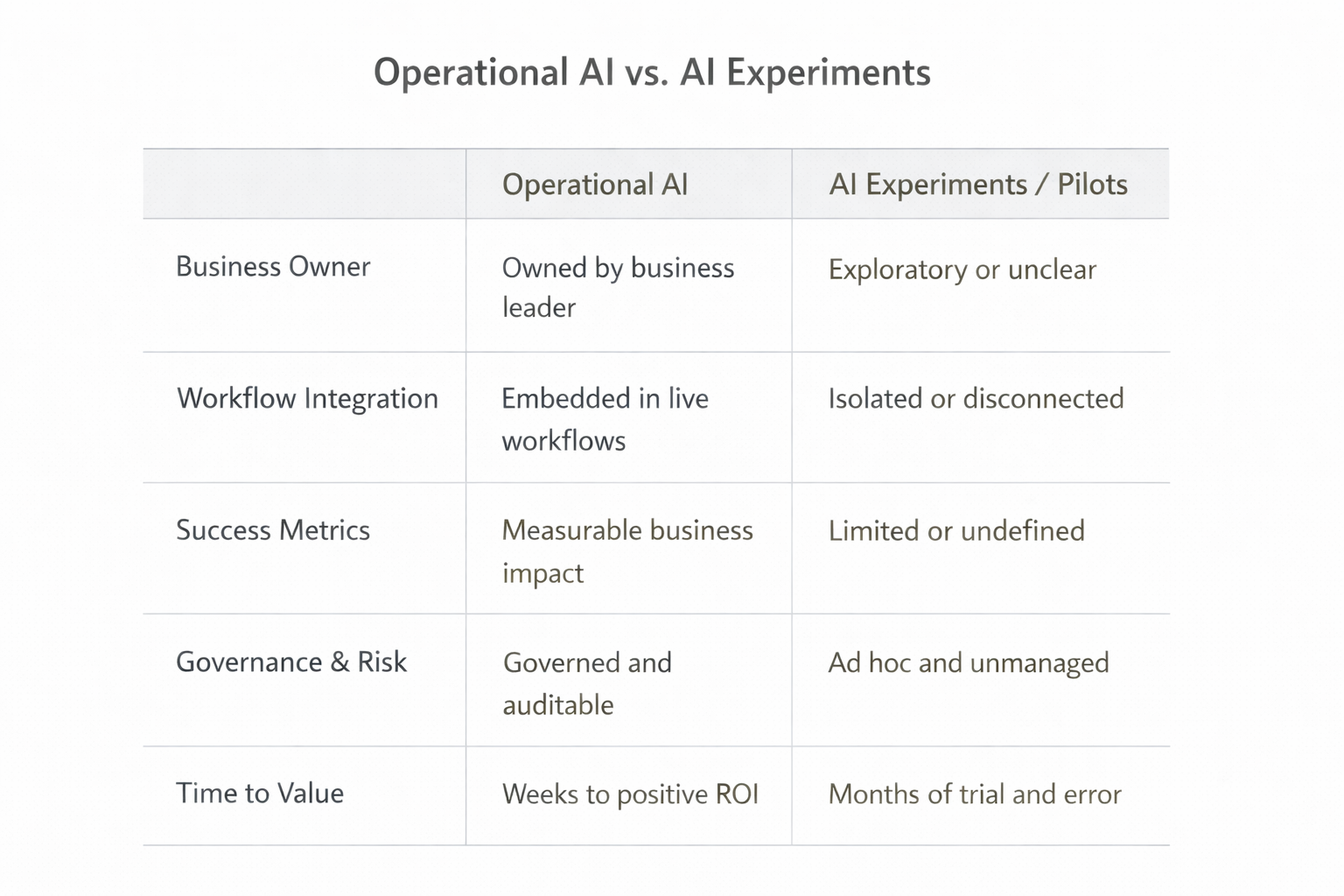
Operational AI vs. AI Experiments
Mid-market executives increasingly feel pressure to “do something with AI.” Vendors promise dramatic gains. Competitors announce pilots. Boards ask pointed questions. Yet many organizations struggle to move beyond experimentation.
A familiar pattern emerges:
- Multiple AI pilots running in parallel, none reaching production
- Local productivity gains that help individuals but fail to move enterprise metrics
- Unclear ownership, with AI sitting between IT, operations, and innovation teams
- Limited visibility into ROI, making it hard to justify continued investment
At the root of the problem is a category mistake. AI is often treated as a technology experiment rather than an operational system.
Successful AI initiatives look less like software demos and more like process redesign efforts supported by new capabilities. When this distinction is missed, pilots proliferate but value does not.
Definitions: Clarifying Key Terms Early
What do we mean by AI in an operational context?
Before going further, it helps to clarify a few terms that are often used loosely.
Operational AI — AI embedded into live business workflows that influence or execute real work, such as invoice processing, scheduling, forecasting, or customer support. Operational AI affects outcomes, not just insights.
AI opportunity — A clearly defined operational problem where AI can improve cost, speed, accuracy, or decision quality. Strong AI opportunities are narrow, measurable, and owned by the business.
AI pilot — A limited, controlled deployment used to validate value and feasibility before broader rollout. A pilot should answer one question clearly: does this create measurable value in our environment?
Feasibility — The practical ability to deploy AI successfully, based on data availability, system integration, governance requirements, and organizational readiness.
Orchestration platform — The systems and tooling that connect AI models to data sources, business applications, workflows, monitoring, and human oversight. This layer enables AI to operate reliably in production.
Key point: Clarity at this level prevents unrealistic expectations later.
Why This Matters for Mid-Market Leaders
What is at stake operationally and financially?
For mid-market organizations, the consequences of getting AI right or wrong are concrete.
Efficiency and labor leverage
Many mid-market firms carry high labor costs tied to manual, repetitive work in finance, operations, HR, and customer service. When applied to the right workflows, AI-driven automation and decision support can reduce processing time by 30–60%, according to multiple industry case studies summarized by McKinsey and Deloitte.
Margins under pressure
Unlike large enterprises, mid-market companies often operate with thinner margins and less room for prolonged experimentation. AI ROI typically appears as avoided cost, reduced rework, or faster throughput, rather than dramatic revenue growth. These incremental gains compound over time.
Customer experience
Faster response times, fewer errors, and more consistent service directly affect retention. Gartner estimates that AI-enabled customer service tools can reduce average handling time by ~20% when properly integrated with systems of record.
Risk and compliance
AI can reduce errors and flag anomalies, but unmanaged AI increases exposure. Regulatory scrutiny is rising, particularly in financial services and healthcare. Leaders need to understand where AI reduces risk and where it introduces new controls requirements.
Competitive positioning
AI is quickly becoming a baseline capability. The risk is not failing to be innovative, but falling behind peers who apply AI pragmatically to core operations.
How AI Applies in Practice Without the Hype
Where does AI actually work and why?
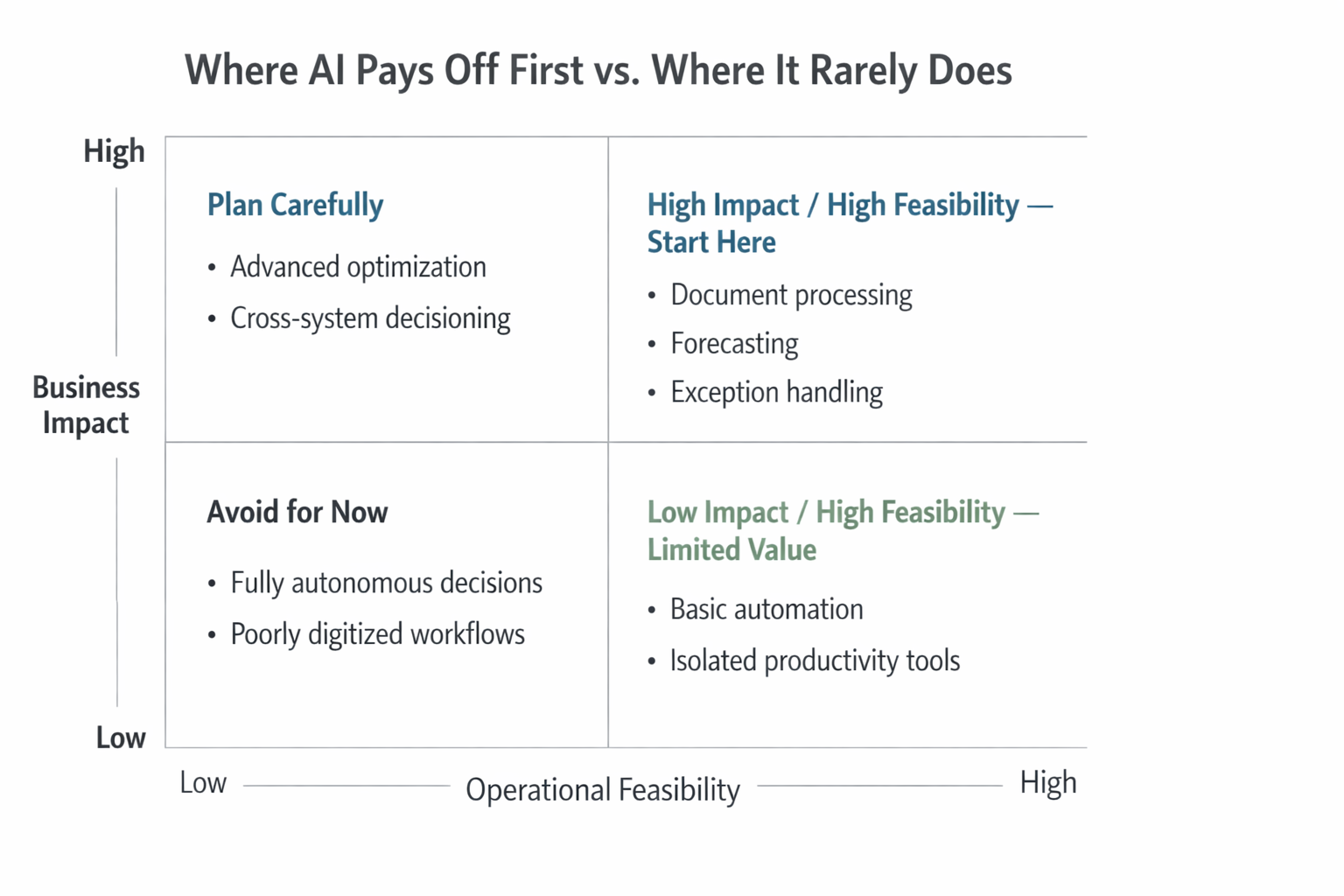
Where AI Pays Off First vs. Where It Rarely Does
Across industries, a consistent pattern appears. AI delivers value fastest when three conditions are present:
- High volume and repetition — The more often a task occurs, the more leverage small improvements create.
- Structured or semi-structured data — Clean inputs matter more than sophisticated models.
- Clear decision rules or outcomes — AI works best when it supports or automates decisions with defined success criteria.
Where AI pays off first
- Document-heavy workflows such as invoice processing, claims intake, or compliance reviews
- Forecasting and planning tasks like demand forecasting or capacity planning
- Exception handling and prioritization in operations or customer service
- Knowledge retrieval and summarization for frontline teams
Where AI rarely pays off initially
- Low-volume, bespoke work that varies widely case by case
- Poorly digitized or undocumented processes
- Decisions requiring deep contextual judgment without guardrails
- Initiatives driven by curiosity rather than business need
Realistic Operational Examples from Non-Tech Industries
What does this look like in real operations?
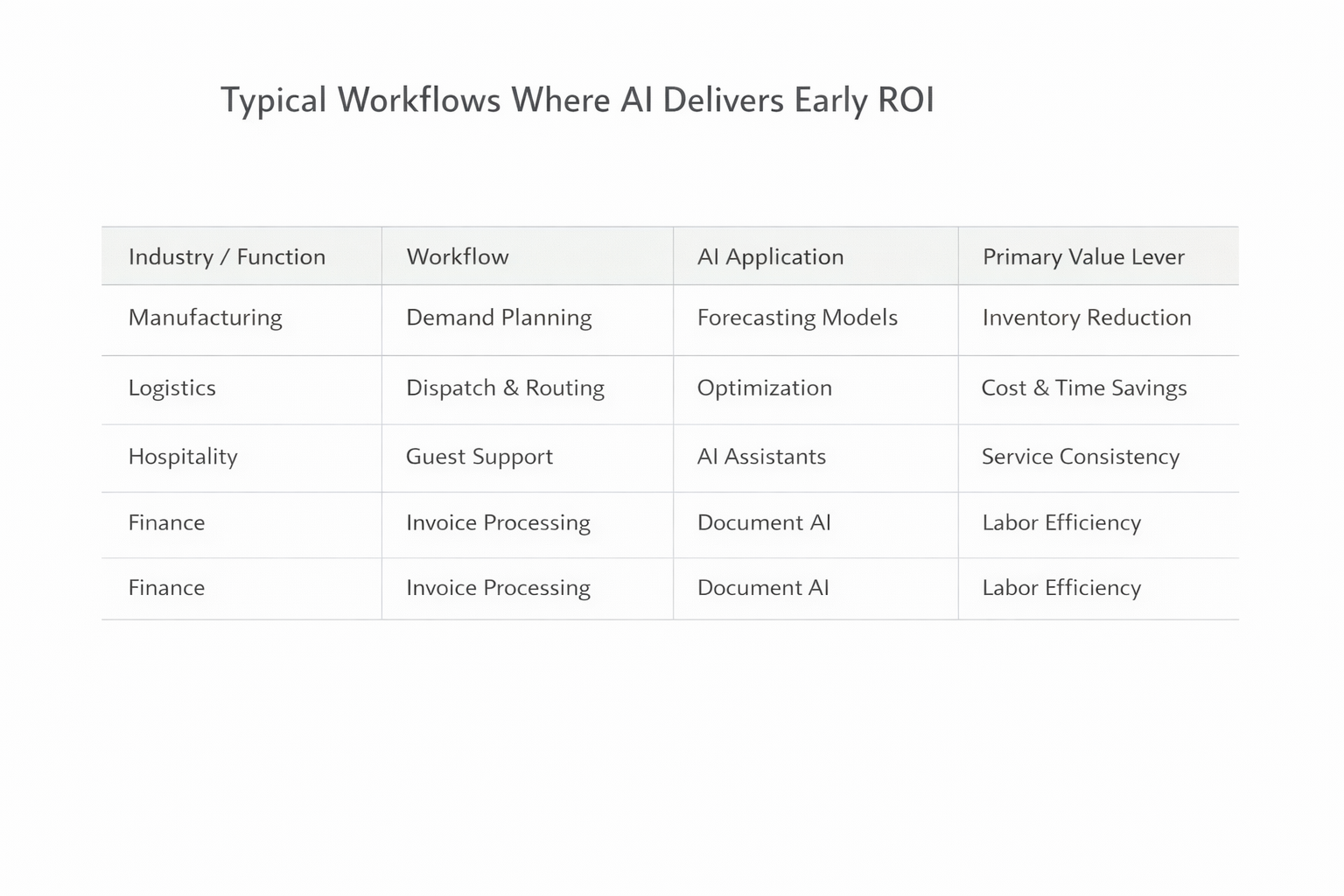
Typical Workflows Where AI Delivers Early ROI
Manufacturing & Industrial
Demand forecasting, inventory optimization, and predictive maintenance combining structured data with clear cost drivers.
Logistics & Field Services
AI-assisted routing, scheduling, and exception management using historical patterns and service constraints.
Hospitality, Healthcare & Services
AI assistants handling routine inquiries, summarizing records, and routing requests to the right teams.
For mid-market organizations, the value typically shows up as reclaimed staff capacity rather than immediate headcount reduction.
Recommended Implementation Steps
How should leaders approach AI without overreach?
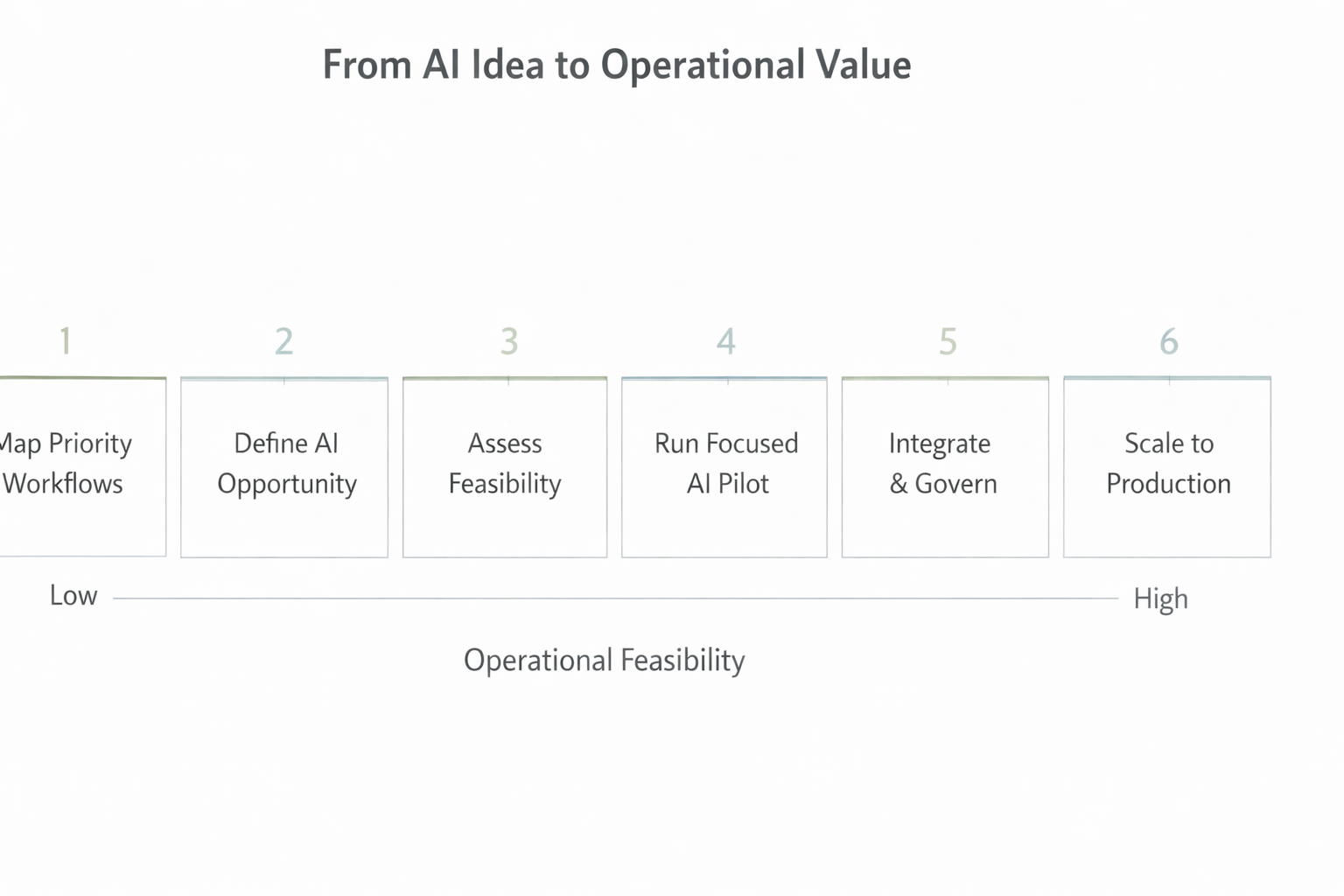
From AI Idea to Operational Value
A disciplined approach materially increases the odds of success:
Map priority workflows
Identify where time, cost, or errors concentrate in your operations.
Define a single AI opportunity
One owner, one metric, one clear business outcome.
Assess feasibility early
Evaluate data availability and integration readiness before committing.
Run a focused AI pilot
Test with real users and real data in a controlled environment.
Design for production
Include monitoring, governance, and human oversight from the start.
Scale selectively
Expand only once value and adoption are proven.
This approach may feel slower at the start, but it delivers faster and more reliable ROI.
Common Pitfalls and How to Avoid Them
What should executives watch out for?
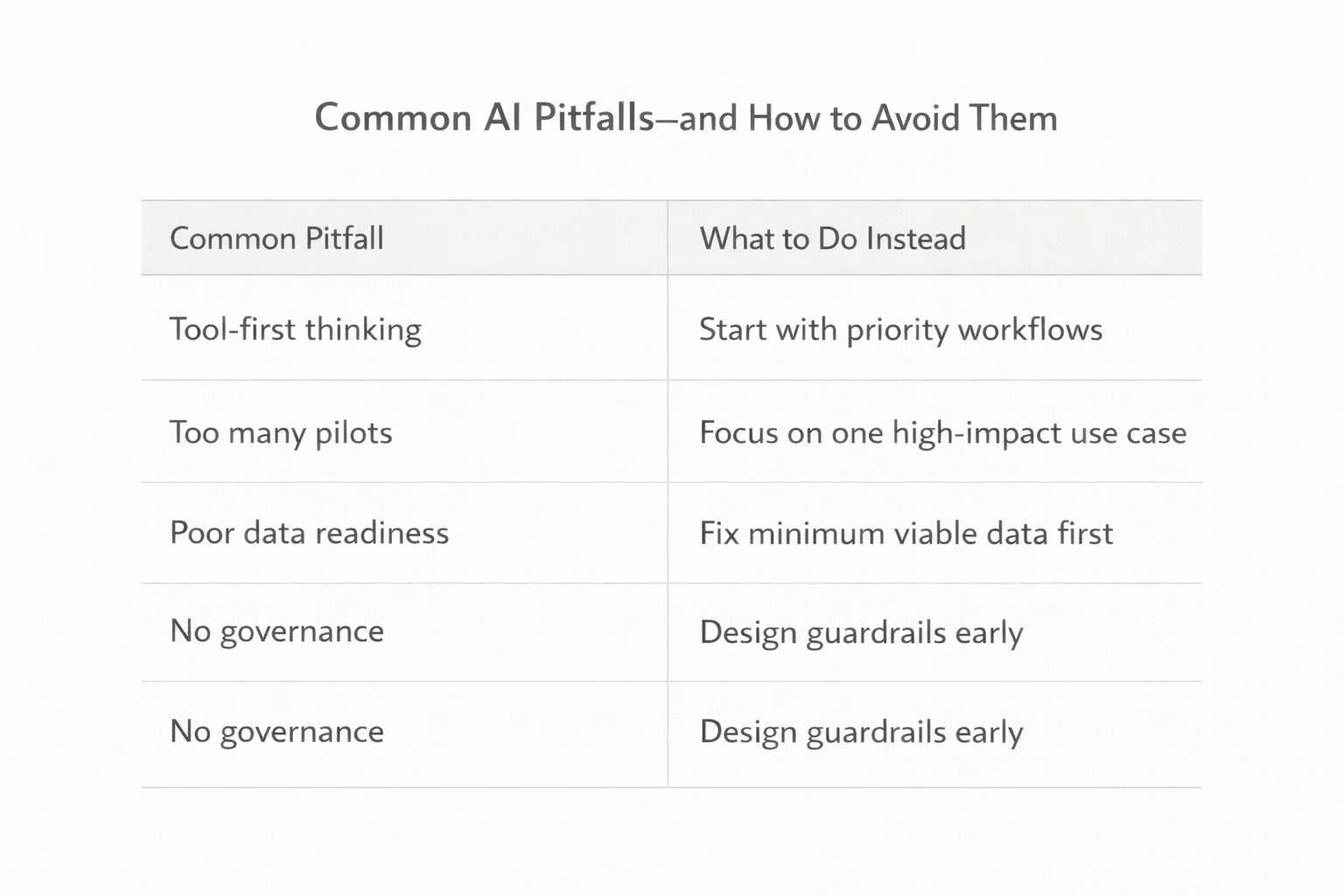
Common AI Pitfalls and How to Avoid Them
Tool-first thinking → Start with workflows, not vendors
Too many pilots → Focus on one high-impact use case
Poor data readiness → Fix minimum viable data first
No governance → Design guardrails early
Overblown expectations → Plan for incremental, compounding gains
When This Approach Does Not Make Sense
Where should leaders pause or reset expectations?
AI is not a universal solution. Leaders should be cautious when:
- Processes are low-volume and highly bespoke
- Decisions are subjective or ethical without clear rules
- Data is fragmented and undocumented
- There is no clear operational owner
Executive FAQ
How long does it typically take to see AI ROI?
Well-scoped pilots often show early operational impact within 8 to 16 weeks, with broader ROI emerging over 6 to 12 months.
Do we need advanced AI talent in-house to start?
Not initially. Clear ownership, domain expertise, and data discipline matter more early than deep technical specialization.
Is generative AI enough on its own?
Rarely. Generative AI creates value when combined with data integration, workflow orchestration, and governance.
Key Takeaways for Business Leaders
- AI pays off first in high-volume, well-defined workflows
- Operational context matters more than model sophistication
- Most AI ROI appears as efficiency and avoided cost, not dramatic growth
- Pilots must validate one clear outcome before scaling
- Governance and integration are prerequisites, not afterthoughts
Ready to Identify Where AI Pays Off?
Sentia Digital helps mid-market organizations prioritize high-impact AI opportunities and validate feasibility before significant investment.
Explore AI Opportunity Assessment →